
Prescription
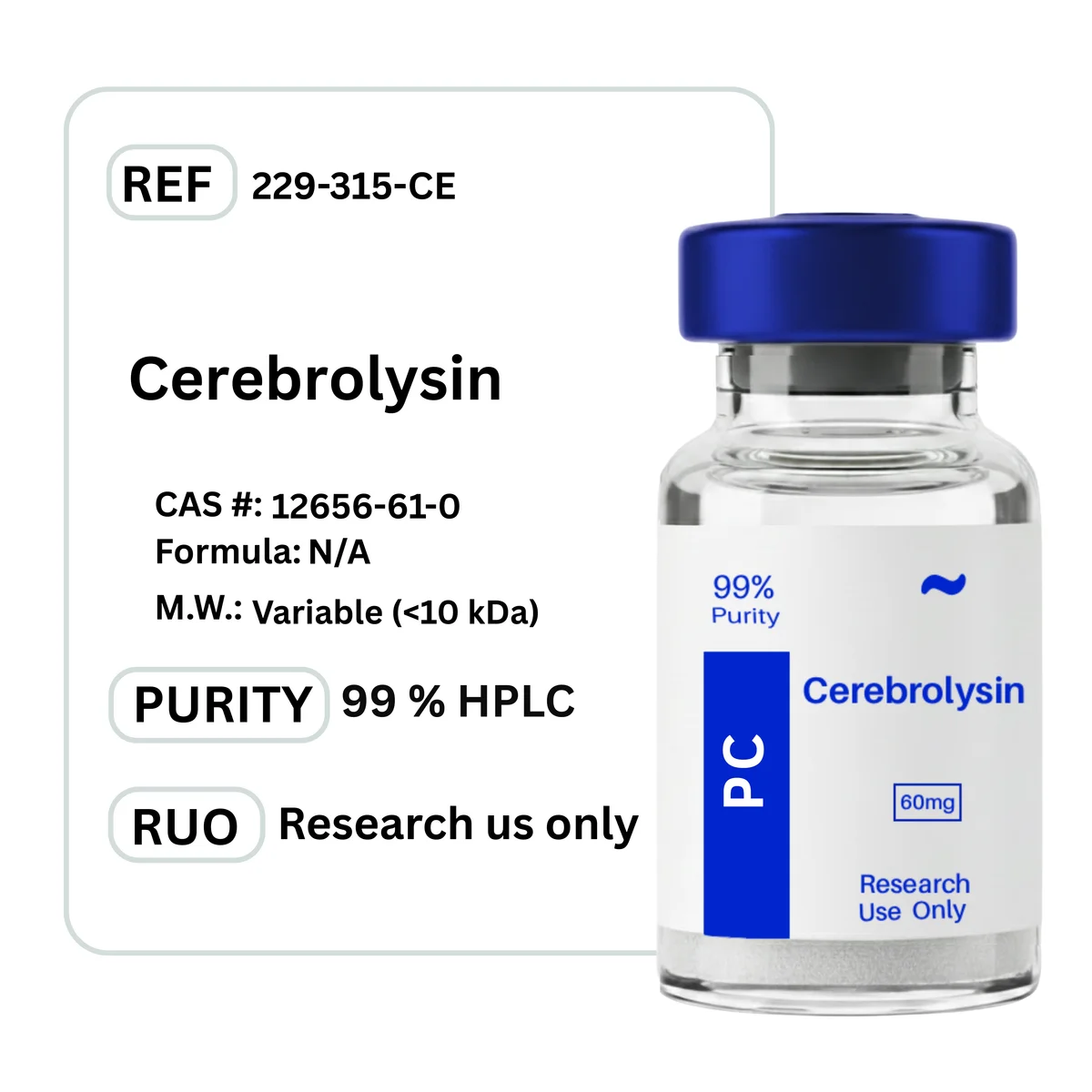
Cerebrolysin
Neuropeptide concentrate studied for cognitive support and neuroregeneration
“A porcine-derived neuropeptide mixture with the most substantial clinical trial record of any nootropic peptide — and the regulatory gap to match.”
Last updated: April 23, 2026
Score Breakdown
Evidence
Purity
Cost Efficiency
Safety Profile
Pros & Cons
Pros
- Among the largest human clinical trial datasets of any nootropic-class peptide, with RCT data in stroke and dementia populations
- Mechanism of action is well-characterized relative to most research peptides, with plausible neurotrophic pathway activity confirmed in preclinical models
- Manufactured as a licensed pharmaceutical in multiple countries, meaning GMP-grade product with verifiable COAs exists (unlike most research chemicals)
- No known dependency or withdrawal profile; cyclical dosing protocols are well-documented in the literature
Cons
- Requires parenteral (IV or IM) administration, making self-use logistically complex and higher risk than subcutaneous peptides
- Not approved by FDA, MHRA, or EMA centrally — importation and use outside approved jurisdictions is legally ambiguous and practically difficult to source safely
- Cochrane-level review found methodological weaknesses in much of the trial base; effect sizes in Western-published trials are modest and clinical significance is debated
- Porcine brain-derived biologic origin creates pathogen and quality control concerns for gray-market sourcing
Best For
- Researchers examining neurotrophic peptide activity in neurodegeneration models
- Clinicians in jurisdictions where Cerebrolysin is licensed studying stroke rehabilitation adjuncts
- Longevity-focused individuals seeking to understand the neuroprotective peptide literature before exploring related compounds
Avoid If
- Epilepsy or known seizure disorder — case reports suggest potential lowering of seizure threshold at high doses
- Renal failure — amino acid load may be contraindicated; clinical trials have generally excluded severe renal impairment
Full Review
Cerebrolysin is a standardized hydrolysate derived from purified porcine brain proteins, manufactured primarily by EVER Neuro Pharma in Austria. It is not a single peptide but rather a complex mixture: approximately 25% low-molecular-weight peptide fragments (under 10,000 Da) and 75% free amino acids. The active peptide fraction is believed to contain fragments with neurotrophic activity, broadly classified under the nootropic and neuroprotective peptide category. It has been marketed and prescribed in Russia, China, South Korea, and several Eastern European countries for decades, primarily as an intravenous or intramuscular injectable solution. In Western regulatory jurisdictions — the US, UK, and most of the EU — it does not hold approved status and is not available through standard prescription channels.
The proposed mechanism of action centers on neurotrophic factor mimicry. Research suggests that Cerebrolysin's peptide fragments act on signaling pathways associated with brain-derived neurotrophic factor (BDNF), nerve growth factor (NGF), and insulin-like growth factor-1 (IGF-1), promoting neuronal survival, axonal sprouting, and synaptic plasticity without the peptides themselves crossing the blood-brain barrier in large quantities. Preclinical models indicate modulation of the PI3K/Akt and MAPK/ERK pathways, which are implicated in neuroprotection and anti-apoptotic signaling. Animal models also report reductions in amyloid precursor protein processing and tau phosphorylation, providing a putative rationale for its investigation in Alzheimer's disease.
The human evidence base for Cerebrolysin is more developed than for most research peptides, though Western regulators have not found it sufficient for approval. Several randomized controlled trials have examined its use in acute ischemic stroke: a 2017 Cochrane systematic review (Ziganshina et al.) analyzed available RCT data and concluded that the evidence was insufficient to support routine use, citing small sample sizes and methodological limitations in many trials. More recent work, including the CASTA trial and studies published in Stroke and CNS Drugs, has reported modest but statistically significant improvements in functional recovery and cognitive outcomes in stroke patients when Cerebrolysin was administered early and at higher intravenous doses. In Alzheimer's disease research, trials including a 2018 double-blind RCT (n=131) reported that Cerebrolysin 30 mL IV over 10 days improved cognitive subscores on the ADAS-Cog versus placebo, though effect sizes were modest. Vascular dementia studies and traumatic brain injury models have similarly produced encouraging but not definitive data. Animal studies — primarily rodent models — consistently show neuroprotective and pro-cognitive effects across a range of injury and neurodegeneration paradigms, lending mechanistic plausibility to the clinical signals.
Dosing ranges reported in clinical research contexts vary considerably by indication. Stroke rehabilitation trials have typically employed 10–30 mL administered intravenously over 21–28 days. Alzheimer's and vascular dementia studies commonly report 10–30 mL IV per session in cyclical protocols, often 10 consecutive treatment days repeated quarterly. Intramuscular administration at lower volumes (1–5 mL) has been used in some outpatient research contexts. These are ranges reported in published research — they are not a recommendation for human use, and self-administration of Cerebrolysin outside a supervised clinical setting carries meaningful risks given its parenteral-only route and complex biological origin. For educational purposes only: nothing in this profile constitutes medical advice or a recommendation to use this compound.
Legal status varies sharply by region. Cerebrolysin is a registered prescription pharmaceutical in Russia, Ukraine, China, South Korea, and several Central and Eastern European countries. It is not FDA-approved in the United States, not MHRA-approved in the United Kingdom, and does not hold EMA centralized approval in the EU (though it is approved in some individual EU member states). In Australia, it is not TGA-registered. In jurisdictions where it lacks approval, it occupies a gray-zone status — not explicitly scheduled as a controlled substance in most cases, but importation for personal use exists in a legally ambiguous space. Sourcing considerations are significant: because Cerebrolysin is a biologic derived from animal tissue, quality control and pathogen-screening standards matter considerably. Legitimate pharmaceutical-grade product carries batch-specific COAs from the manufacturer, clear chain of custody, and is produced under GMP conditions. Gray-market vials without verifiable manufacturing provenance carry meaningful contamination and authenticity risks that are compounded by the injectable route of administration.
Details
Reviews
No reviews yet. Be the first to share your experience.
Featured In
PEPTIDE-PROFILE
Cerebrolysin: Neurological Peptide Research Summary — What the Clinical Evidence Actually Shows
Cerebrolysin is a standardized porcine brain-derived peptide hydrolysate, composed of roughly 25% low-molecular-weight peptides and 75% free amino acids, manufactured by EVER Neuro Pharma in Austria and licensed as a prescription pharmaceutical in over 40 countries across Central/Eastern Europe, Asia, and Latin America for stroke and dementia indications. It is not FDA-, MHRA-, EMA-, or TGA-approved. Randomized controlled trials spanning several decades report neurotrophic and neuroprotective effects via BDNF/NGF-like activity, though Cochrane reviewers have flagged methodological limitations including small sample sizes, incomplete blinding, and publication-standard concerns across the supporting trial base.
PEPTIDE-PROFILE
Semax: What the Research Actually Shows on the Russian Nootropic Peptide
Semax is the strongest option among the nootropic research peptides reviewed here because it combines a reasonably well-characterized mechanism (BDNF upregulation, ACTH analog activity) with genuine pharmaceutical registration in Russia and a published clinical trial record - but that evidence base is heavily concentrated in Russian-language literature and hasn't been independently replicated under Western regulatory standards, which limits how much confidence the available data can actually support.