
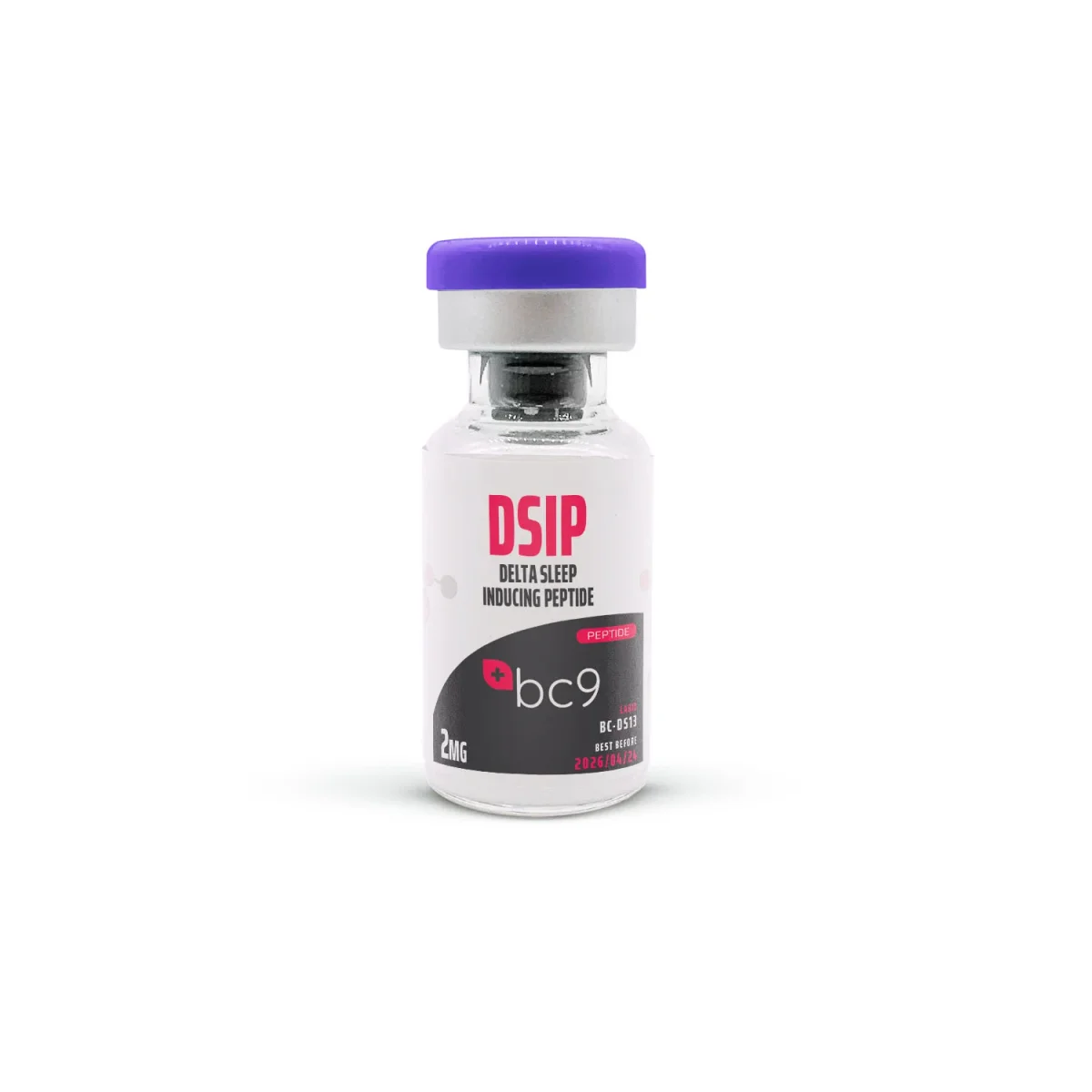
Research Peptide
DSIP (Delta Sleep-Inducing Peptide)
Endogenous sleep peptide with stress-modulating properties
“A naturally occurring sleep peptide with a decades-long research history and a conspicuous absence of modern clinical trials.”
Last updated: April 23, 2026
Score Breakdown
Evidence
Purity
Cost Efficiency
Safety Profile
Pros & Cons
Pros
- Endogenous peptide with established natural presence in human cerebrospinal fluid — not a fully synthetic compound
- Very low acquisition cost relative to most research peptides
- Relatively benign side-effect profile observed in small human studies, particularly at subcutaneous doses
- Preliminary evidence of HPA-axis and cortisol-modulating activity beyond simple sedation may broaden research interest
Cons
- No modern, adequately powered RCTs in humans — the evidence base largely stalled after the 1980s-90s
- Short half-life and uncertain subcutaneous bioavailability complicate both research design and practical protocols
- No clearly characterized receptor, making mechanism-of-action claims speculative relative to better-studied peptides
Best For
- Researchers specifically investigating endogenous sleep-modulating neuropeptides and delta-wave architecture
- Biohackers exploring HPA axis and stress-response modulation alongside established interventions
- Investigators studying opiate-withdrawal symptom models in preclinical settings
Avoid If
- Seeking peptides with robust, replicated human clinical trial data before considering research use
- Hypotension or cardiovascular instability is a known concern — early IV studies noted transient blood pressure drops
Full Review
DSIP (Delta Sleep-Inducing Peptide) is a nine-amino-acid neuropeptide (Trp-Ala-Gly-Gly-Asp-Ala-Ser-Gly-Glu) with an unusual amphiphilic structure that allows it to cross the blood-brain barrier — a relatively rare property among peptides. It was first isolated in 1974 by Monnier and colleagues from the cerebral venous blood of rabbits whose thalami had been electrically stimulated to induce sleep, making it one of the earliest endogenous sleep-modulating compounds identified in modern neuroscience. It belongs to the loose functional class of 'sleep peptides' and is sometimes categorized alongside other endogenous neuromodulatory peptides, though it shares no structural homology with better-characterized sleep regulators like orexin antagonists or melatonin precursors.
The mechanism of action for DSIP is not fully elucidated and remains a subject of ongoing debate. Early research proposed that it acts on delta-wave sleep architecture by modulating thalamic and hypothalamic activity, suppressing somatostatin release, and interacting with opiate receptors. More recent investigations suggest DSIP may function as a stress-limiter peptide: animal studies have indicated effects on hypothalamic-pituitary-adrenal (HPA) axis regulation, with some evidence pointing to cortisol normalization rather than simple sedation. Research has also noted potential interactions with LH and GH secretion patterns, raising interest in its relevance beyond sleep per se. No single, well-validated receptor for DSIP has been formally characterized, which complicates mechanistic interpretation considerably.
The evidence base for DSIP is genuinely mixed and requires careful stratification by study type. Animal studies — predominantly in rabbits, rats, and cats — consistently support delta-wave sleep induction and stress-attenuation effects when DSIP is administered centrally or intravenously. A small number of human studies were conducted in the 1980s and 1990s, including work by Schneider-Helmert (1985) examining DSIP in chronic insomnia patients (n=20–30 range, small crossover designs), which reported improvements in sleep quality metrics. A separate line of investigation explored DSIP in opiate withdrawal contexts, with a 1988 Swiss trial suggesting symptomatic relief — though sample sizes were in the single digits to low tens and methodology has not been replicated at scale. More recent human data is essentially absent; the bulk of post-2000 research has been mechanistic or conducted in rodent models. User self-reports in biohacker communities describe variable results, with some reporting subjectively deeper sleep and faster sleep onset, and others noting negligible effects — the classic pattern for a peptide with inconsistent bioavailability and no standardized delivery protocol.
Dosing ranges reported in the published research literature vary considerably. Intravenous administration in human studies typically used doses in the range of 25–50 mcg/kg bodyweight, while intranasal protocols in animal research used lower absolute doses. Some self-reported human protocols in the research community reference 100–500 mcg subcutaneous doses, though this range is derived from anecdotal extrapolation rather than controlled human pharmacokinetic trials. IMPORTANT DISCLAIMER: All dosing information above is reported strictly from published research contexts and self-reported community sources — it does not constitute a recommendation for human use, and DSIP is not approved for therapeutic administration in any major jurisdiction. This content is for educational purposes only.
In terms of legal status, DSIP occupies the standard research-chemical grey zone across most Western jurisdictions. It is not a scheduled or controlled substance in the US, UK, EU, or Australia, meaning it can be legally sold for laboratory research purposes but is not approved for human use. Given its endogenous nature, it is not patentable in its native form, which has likely contributed to the lack of pharmaceutical investment and formal clinical development. Sourcing considerations follow the standard framework for research peptides: buyers should require a certificate of analysis (COA) from a third-party analytical laboratory confirming sequence identity, purity (HPLC ≥98%), and absence of endotoxins. Given the nine-amino-acid structure, sequence verification via mass spectrometry is particularly important as truncated or degraded forms are structurally similar. Vendors who do not provide mass-spec-confirmed COAs on request should be treated with caution.
Details
Reviews
No reviews yet. Be the first to share your experience.
Featured In
STACK
Sleep Peptide Research Stack: DSIP, Selank, and Supporting Compounds for Sleep Quality and Recovery
For researchers building a sleep-focused peptide protocol, Selank is the strongest starting point among the three compounds covered here - it has at least some institutional clinical framework (including a formal approval in Russia), a non-invasive intranasal delivery route, and a mechanistic profile that connects anxiolytic signaling to downstream sleep architecture improvement in a way DSIP's stalled trial record and Epithalon's longevity-adjacent hypothesis simply don't match right now.
PEPTIDE-PROFILE
DSIP (Delta Sleep-Inducing Peptide): Research Summary and Evidence Review
DSIP (Delta Sleep-Inducing Peptide) is an endogenous nonapeptide (sequence Trp-Ala-Gly-Gly-Asp-Ala-Ser-Gly-Glu) isolated in 1977 from rabbit cerebral venous blood by Marcel Monnier's group at the University of Basel. Over 150 papers were published through the mid-1990s reporting effects on slow-wave sleep, HPA-axis activity, and opiate withdrawal in small human and animal cohorts, but research largely stalled thereafter, and no DSIP receptor has been characterized. It is not FDA-approved for any indication and remains a research-only compound with no modern adequately powered randomized controlled trials.
PEPTIDE-PROFILE
Selank: What the Research Shows on the Russian Anxiolytic Peptide (2026 Evidence Review)
Selank is a Russian-developed anxiolytic heptapeptide - a tuftsin analog with the sequence Thr-Lys-Pro-Arg-Pro-Gly-Pro - registered in Russia as a 0.15% intranasal pharmaceutical. Institutional trials, including a 62-patient randomized comparison against the benzodiazepine medazepam (Zozulya 2008), report comparable anxiolytic effect without the sedation, tolerance, or dependence of classical anxiolytics, through GABA-modulatory and enkephalinase-inhibiting mechanisms. The critical limitation: essentially none of this evidence has been independently replicated outside Russia.