
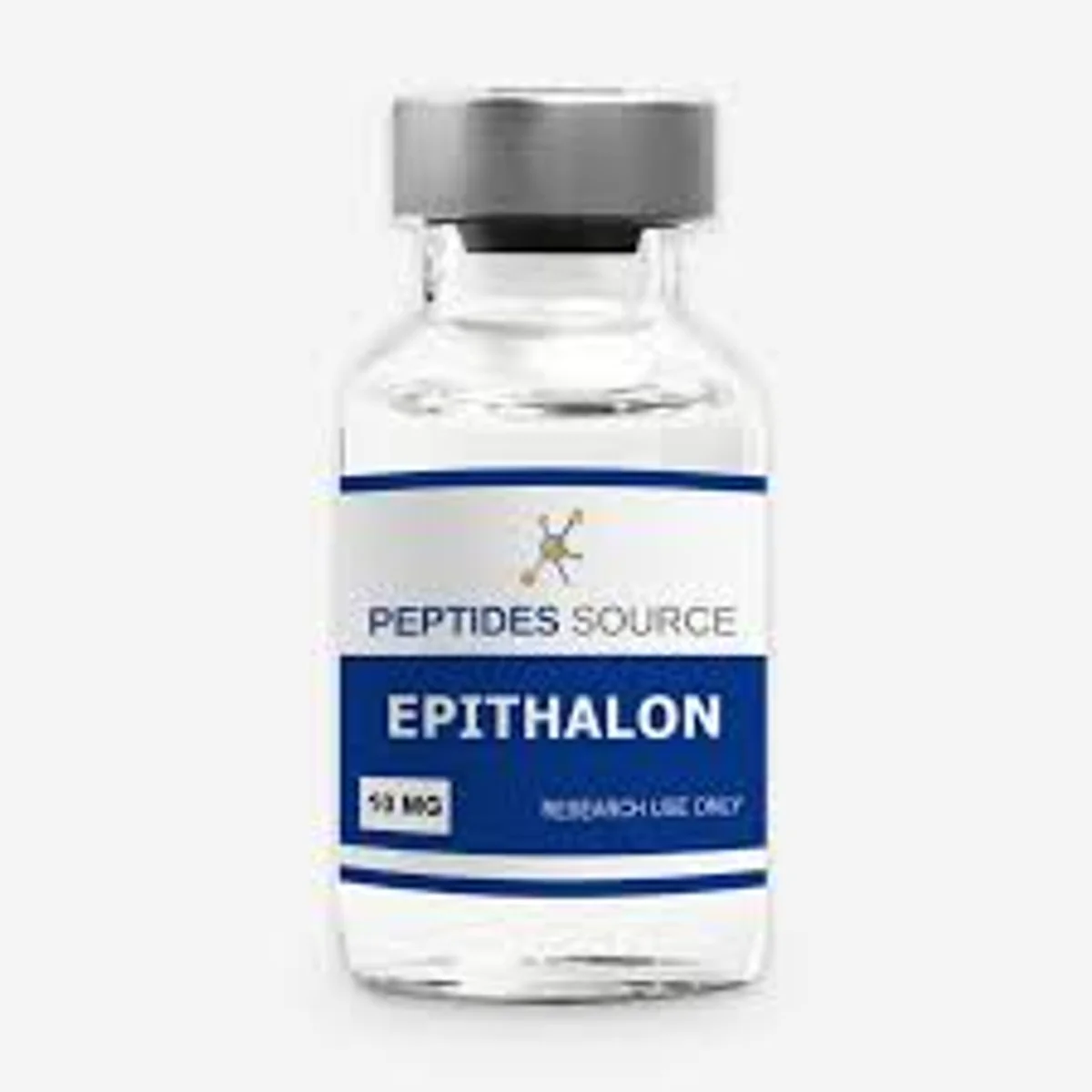
Research Peptide
Epithalon
Telomere-targeting bioregulator peptide under longevity research
“A Soviet-era pineal bioregulator peptide studied for telomerase activation and longevity — intriguing mechanistic profile, evidence base requires independent replication.”
Last updated: April 23, 2026
Score Breakdown
Evidence
Purity
Cost Efficiency
Safety Profile
Pros & Cons
Pros
- One of very few peptides with any human-level published data, however limited in scope
- Proposed telomerase-activation mechanism aligns with established cellular aging theory
- Relatively benign reported side-effect profile across available literature
- Low molecular weight tetrapeptide — well-characterized chemical identity and synthesis
Cons
- Evidence base is heavily concentrated in a single Russian research group with limited independent replication
- No large, randomized, placebo-controlled human trials published in high-impact international journals
- Long-term effects of exogenous telomerase activation in humans are not established — theoretical oncological concerns have not been fully ruled out
Best For
- Longevity researchers investigating telomere biology and pineal peptide bioregulators
- Biohackers with existing familiarity with peptide bioregulator frameworks seeking circadian or neuroendocrine modulation research
- Research contexts focused on aging biomarkers, antioxidant enzyme expression, or melatonin pathway modulation
Avoid If
- Personal or family history of hormone-sensitive cancers — theoretical telomerase upregulation warrants caution pending further research
- Seeking well-replicated, RCT-supported compounds — the evidence base here does not meet that standard
Full Review
Epithalon is a synthetic tetrapeptide (four amino acids: Ala-Glu-Asp-Gly) classified as a peptide bioregulator — a subclass of short peptides developed largely within Soviet and post-Soviet gerontological research programs. It is the synthetic analog of epithalamin, a polypeptide fraction extracted from bovine pineal gland tissue. The broader bioregulator framework, pioneered by Vladimir Khavinson and colleagues at the St. Petersburg Institute of Bioregulation and Gerontology, theorizes that short peptides can penetrate cell nuclei and modulate gene expression in a tissue-specific manner. Epithalon is specifically associated with pineal gland and neuroendocrine function. It is not approved for human therapeutic use by the FDA, MHRA, EMA, or TGA, and is sold as a research chemical in most jurisdictions. This content is for educational purposes only and does not constitute medical advice.
The proposed mechanism of action centers on telomerase activation. In vitro and animal studies have reported that Epithalon may stimulate telomerase enzyme activity, potentially slowing the shortening of telomeres — the protective end-caps of chromosomes that erode with each cell division. Shortened telomeres are a recognized hallmark of cellular aging. Separately, research suggests Epithalon may influence melatonin synthesis and secretion from the pineal gland, possibly by upregulating expression of genes involved in the melatonin synthesis pathway. Animal models have also reported effects on antioxidant enzyme activity (superoxide dismutase, catalase), circadian rhythm normalization in aged subjects, and modulation of neuroendocrine hormone profiles including LH and FSH. The mechanistic logic is plausible at the cellular level, but translational evidence to human outcomes remains preliminary.
The evidence base for Epithalon is unusual by Western clinical standards. The majority of published trials originate from a single Russian research group (Khavinson et al.), and many were conducted in the 1990s through 2010s with small sample sizes. Human studies — some involving elderly patients, others involving patients with specific age-related conditions — have reported associations with improved antioxidant status, normalized melatonin levels, and in one reported cohort study, reduced all-cause mortality over a 15-year follow-up period compared to untreated controls. However, these studies have not been replicated by independent research groups in large randomized controlled trials, and several are published in journals with limited international peer review infrastructure. Animal studies (primarily rodent and primate models) report extended lifespan, reduced tumor incidence, and improved retinal function in aged animals. In vitro studies on human fetal fibroblasts have reported telomere elongation. Anecdotal self-reports in longevity and biohacking communities describe improved sleep quality, sense of well-being, and subjective energy — though these reports are uncontrolled and subject to placebo effects. The human evidence should be characterized as human-preliminary, not human-RCT.
Dosing ranges reported in published research vary considerably. Animal studies have used doses scaled to body weight that are difficult to directly extrapolate. In human study contexts, doses reported in the literature have ranged from approximately 5 mg to 10 mg per administration, delivered via subcutaneous or intramuscular injection, administered daily or on alternating days over cycles of 10 to 20 days, sometimes repeated at intervals of several months. Some protocols in older Russian literature describe intranasal or oral administration, though bioavailability data for non-injectable routes is not well characterized. These dosing figures are reported strictly in the context of describing published research — they do not constitute a dosing recommendation, and no safe or effective dose for human use has been established by any regulatory authority.
Legally, Epithalon occupies a gray area in most major jurisdictions. In the United States, it is not scheduled under the DEA Controlled Substances Act and is not FDA-approved, placing it in the research-chemical category — legal to purchase for laboratory research but not for human consumption. The UK and EU situation is similarly unregulated at the specific compound level, though broader regulations on unlicensed medicines apply. In Australia, unapproved peptides face stricter scrutiny under TGA scheduling. Sourcing considerations are significant: credible vendors should provide third-party certificates of analysis (COA) confirming amino acid sequence, purity (HPLC), sterility, and endotoxin levels. Lyophilized powder form is standard; reconstitution with bacteriostatic water is required prior to use in research settings. Vials should be stored frozen prior to reconstitution and refrigerated after. Red flags include vendors lacking downloadable COAs, no batch-specific testing, or products shipped without age verification.
Details
Reviews
No reviews yet. Be the first to share your experience.
Featured In
STACK
The Longevity Stack: How Epithalon, MOTS-c, and Thymosin Alpha-1 Are Studied Together

The longevity peptide stack pairing Epithalon, MOTS-c, and Thymosin Alpha-1 is a research-only combination targeting three distinct hallmarks of aging: telomere attrition, mitochondrial dysfunction, and immunosenescence, respectively. None of the three compounds carry FDA, MHRA, or TGA approval for human administration, and the evidence base is highly uneven—Thymosin Alpha-1 has decades of clinical RCT data, MOTS-c has solid mechanistic and animal research with emerging human studies, and Epithalon's literature, though substantial in volume, originates largely from a single Russian research group (the Khavinson laboratory) with limited independent Western replication.
STACK
Sleep Peptide Research Stack: DSIP, Selank, and Supporting Compounds for Sleep Quality and Recovery
For researchers building a sleep-focused peptide protocol, Selank is the strongest starting point among the three compounds covered here - it has at least some institutional clinical framework (including a formal approval in Russia), a non-invasive intranasal delivery route, and a mechanistic profile that connects anxiolytic signaling to downstream sleep architecture improvement in a way DSIP's stalled trial record and Epithalon's longevity-adjacent hypothesis simply don't match right now.
PEPTIDE-PROFILE
Spermidine: Autophagy and Cellular Renewal — What the Research Actually Shows
For researchers evaluating spermidine supplementation, it's one of the few longevity compounds with a completed human RCT, a well-characterized endogenous mechanism via EP300 inhibition and autophagy induction, and a decent safety profile at dietary-range doses. The evidence is still preliminary - but it's meaningfully more developed than most compounds in this space, and that distinction matters.
PEPTIDE-PROFILE
Epithalon (Epitalon): Telomere Bioregulator Research Summary 2026
Epithalon (also spelled Epitalon) is a synthetic tetrapeptide with the sequence Ala-Glu-Asp-Gly, developed by Vladimir Khavinson and colleagues at the St. Petersburg Institute of Bioregulation and Gerontology beginning in the 1980s as a synthetic analog of the pineal extract Epithalamin. Its proposed mechanism is telomerase activation via upregulation of the TERT gene, and a published human-evidence base exists across roughly four decades of research. However, nearly all human trial data originates from that single Russian laboratory, with no meaningful independent replication, and Epithalon holds no FDA approval.
CATEGORY-OVERVIEW
Longevity and Anti-Aging Peptides: The 2026 Research Landscape — A Complete Category Overview
If you're evaluating longevity peptides by evidence quality rather than marketing copy, SS-31 (Elamipretide) is the most evidentially grounded research-chemical-status compound in this category. It's completed registered Phase II and Phase III human trials, has a well-characterized mitochondrial mechanism, and has a documented safety profile - though its Phase III primary endpoint failure means the clinical translation question is still genuinely open.