
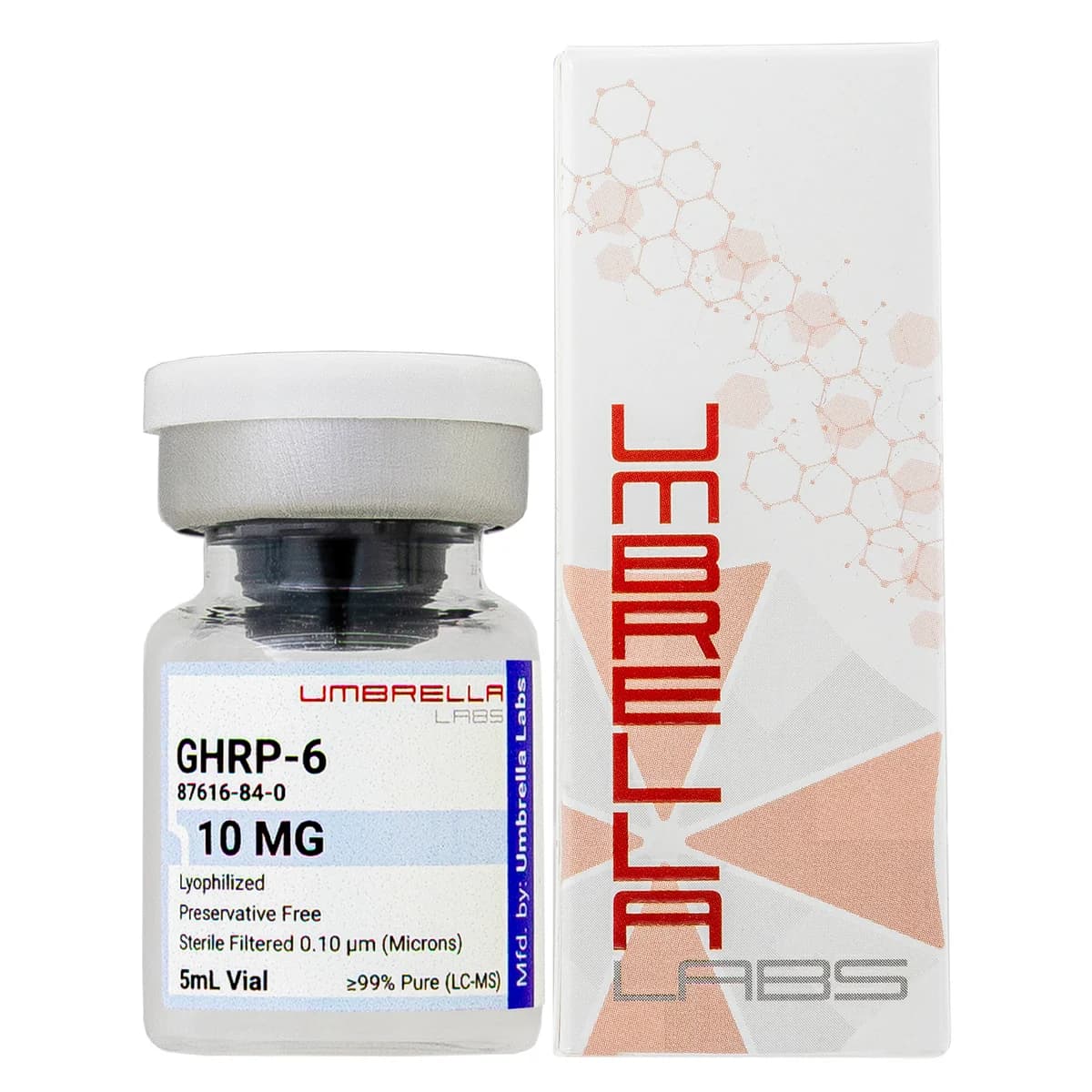
Research Peptide
GHRP-6
Classic growth hormone secretagogue with appetite-stimulating profile
“One of the earliest and most-studied synthetic GH secretagogues, with a well-documented but appetite-heavy research profile.”
Last updated: June 1, 2026
Score Breakdown
Evidence
Purity
Cost Efficiency
Safety Profile
Pros & Cons
Pros
- One of the most extensively researched synthetic GHRPs with over three decades of published data
- Well-characterized mechanism via GHS-R1a receptor with documented human GH-stimulating activity
- Low cost per milligram relative to newer secretagogues makes it accessible for research budgets
- Synergistic GH-release when combined with GHRH analogs (e.g., CJC-1295) documented in research
Cons
- Pronounced appetite stimulation and cortisol/prolactin co-elevation complicate its side-effect profile relative to cleaner alternatives like ipamorelin
- Short half-life (~30–60 minutes) necessitates multiple daily injections to sustain research protocols
- GH response attenuation with repeated dosing (tachyphylaxis) documented in literature, limiting sustained utility
Best For
- Researchers studying GHS-R1a receptor pharmacology and GH pulse dynamics
- Combination secretagogue protocols where GHRH-analog synergy is the study focus
- Budget-conscious research contexts where cost-per-dose is a primary constraint
Avoid If
- Research subjects with active malignancies, as GH and IGF-1 elevation may theoretically accelerate tumor proliferation
- Protocols where appetite stimulation or cortisol elevation would confound outcome variables or are clinically undesirable
Full Review
GHRP-6 (His-D-Trp-Ala-Trp-D-Phe-Lys-NH2) is a synthetic hexapeptide belonging to the growth hormone releasing peptide (GHRP) class — a family of compounds that act as ghrelin mimetics rather than analogs of growth hormone releasing hormone (GHRH). Developed in the early 1980s by researchers including Cyril Bowers, GHRP-6 was among the first synthetic secretagogues studied systematically and served as a foundational research tool for mapping the GHS-R1a receptor system. It is structurally unrelated to natural GHRH and operates through a distinct pathway, making it combinable with GHRH analogs in research protocols without competitive inhibition. It is not approved for human use by the FDA, MHRA, EMA, or TGA, and is classified as a research chemical in most jurisdictions. This content is for educational purposes only and does not constitute medical advice.
Mechanistically, GHRP-6 binds to the growth hormone secretagogue receptor type 1a (GHS-R1a), the same receptor activated by the endogenous hormone ghrelin. This binding triggers a signaling cascade involving phospholipase C and intracellular calcium mobilization in pituitary somatotrophs, stimulating pulsatile growth hormone release. Unlike GHRH analogs, GHRP-6 also partially inhibits somatostatin — the GH-suppressing hormone — thereby amplifying its net GH-stimulating effect. Research additionally documents activation of GHS-R1a receptors in the hypothalamus and brainstem, which accounts for the compound's well-characterized appetite-stimulating effects. Studies also suggest downstream engagement of IGF-1 pathways, though the magnitude and duration of these effects in humans vary considerably between individuals and dosing protocols.
The evidence base for GHRP-6 is more substantive than many research peptides, though important distinctions apply. Human trials from the 1990s and early 2000s — including studies published in journals such as the Journal of Clinical Endocrinology and Metabolism — documented significant acute GH pulses following intravenous or subcutaneous administration in both healthy volunteers and GH-deficient patients. Several studies used sample sizes in the range of 8–30 subjects and consistently demonstrated 3–7 fold increases in serum GH concentrations relative to baseline. A notable limitation is that the majority of human data focuses on acute GH release rather than long-term functional outcomes such as body composition, recovery metrics, or IGF-1 normalization. Animal studies — primarily in rodents — have explored cardioprotective and anti-inflammatory properties attributed to GHS-R1a activation independent of GH release, though translation of these findings to human physiology remains unestablished. Self-reported user data from forums and biohacker communities frequently describe improved recovery, sleep quality, and increased appetite, but these reports are anecdotal and uncontrolled.
Dosing ranges reported in published human research contexts have varied considerably depending on administration route and study design. Intravenous doses used in acute GH stimulation studies have ranged from approximately 1 mcg/kg to 2 mcg/kg body weight. Subcutaneous dosing protocols in research settings have commonly examined ranges of 100–300 mcg per injection, administered in fasted states to maximize GH pulse amplitude. Some research protocols have evaluated multiple daily injections. These figures are reported strictly as ranges observed in published research contexts — they do not constitute a dosing recommendation, and no responsible interpretation of this data should substitute for clinical oversight. Blunting of GH response with repeated dosing (tachyphylaxis) has been documented in research, and many study designs incorporate pulsatile rather than continuous dosing to mitigate this effect.
Legally, GHRP-6 occupies the research-chemical category in the United States — it is not scheduled under the Controlled Substances Act but is not approved for human use or sale as a drug or dietary supplement. In the UK, it is similarly unscheduled but cannot be legally marketed for human consumption. In Australia, GHRP-6 falls under Schedule 4 of the SUSMP as a prescription-only substance, making unsupervised possession and use legally precarious. EU status varies by member state but generally defaults to research-chemical categorization absent EMA approval. Sourcing considerations are significant: credible vendors should provide HPLC and mass spectrometry certificates of analysis confirming identity and purity above 98%, disclose manufacturing origin (preferably with GMP-aligned practices), and require age verification. Lyophilized powder is the standard presentation; reconstitution with bacteriostatic water is required. Red flags include undisclosed synthesis sources, absent or template-style COAs, and vendors offering pre-mixed solutions without stability data.
Details
Reviews
No reviews yet. Be the first to share your experience.