
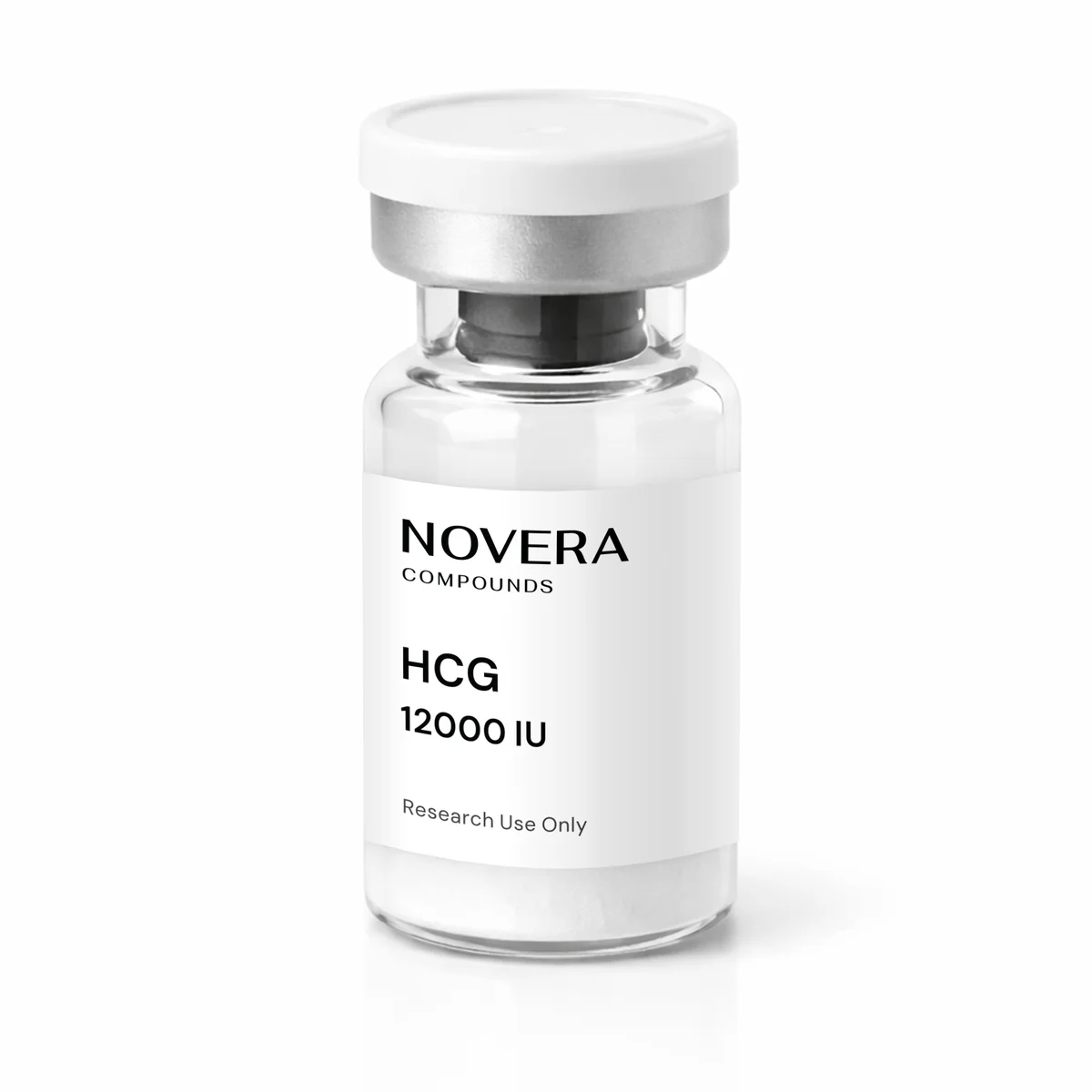
Prescription
HCG (Human Chorionic Gonadotropin)
Gonadotropin hormone for fertility and hormonal support
“An FDA-approved gonadotropin hormone with decades of clinical research supporting fertility and hormonal axis maintenance applications.”
Last updated: June 1, 2026
Score Breakdown
Evidence
Purity
Cost Efficiency
Safety Profile
Pros & Cons
Pros
- FDA-approved prescription drug with a decades-long safety and efficacy record in specific indications
- Well-characterized mechanism via LH-receptor binding with strong mechanistic and clinical literature
- Widely available through licensed pharmacies and telehealth prescribers with established supply chains
- Research supports its utility for preserving testicular function and intratesticular testosterone during TRT
Cons
- Requires a valid prescription in all major jurisdictions — access requires physician involvement and ongoing monitoring
- Risk of ovarian hyperstimulation syndrome (OHSS) in females represents a potentially serious adverse event requiring clinical supervision
- Gynecomastia risk in males due to aromatization of elevated testosterone; testicular desensitization possible with chronic high-dose use
Best For
- Males on testosterone replacement therapy seeking to preserve fertility and testicular volume under physician supervision
- Men with hypogonadotropic hypogonadism seeking to stimulate endogenous testosterone production (clinical context)
- Women undergoing medically supervised fertility protocols requiring ovulation triggering or induction
Avoid If
- Hormone-sensitive cancers (prostate, breast, or testicular) — hCG may stimulate tumor growth via androgen axis activation
- Precocious puberty in pediatric patients or any context without physician diagnosis and monitoring — inappropriate dosing carries significant endocrine disruption risk
Full Review
Human Chorionic Gonadotropin (hCG) is a naturally occurring glycoprotein hormone consisting of two subunits — an alpha subunit shared with LH, FSH, and TSH, and a beta subunit that is unique to hCG and responsible for its distinct biological activity. It is produced by syncytiotrophoblast cells of the placenta following implantation and serves as the hormonal signal that sustains early pregnancy by preventing luteal regression. Pharmacologically, it has been available since the 1930s in injectable form, with FDA-approved branded formulations including Novarel, Pregnyl, and Ovidrel (choriogonadotropin alfa). It belongs to the gonadotropin class of hormones and is not a peptide in the traditional research-chemical sense — it is a 237-amino-acid glycoprotein and a fully approved prescription drug in the US, UK, EU, and Australia for specific clinical indications. This profile is provided for educational purposes only and does not constitute medical advice.
The mechanism of action centers on hCG's structural homology to luteinizing hormone (LH). hCG binds with high affinity to LH/hCG receptors on Leydig cells in the testes and on granulosa and theca cells in the ovaries. In males, this stimulates testicular testosterone production and supports spermatogenesis — the same biological pathway that endogenous LH activates during the hypothalamic-pituitary-gonadal (HPG) axis cycle. In females, a timed hCG injection triggers the LH surge required for final oocyte maturation and ovulation. This receptor-level mimicry is why hCG is used in fertility protocols: it functionally substitutes for endogenous LH when the axis is suppressed or insufficient.
The evidentiary base for hCG is comparatively robust by peptide-research standards, as multiple randomized controlled trials and decades of clinical use underpin its approved indications. In males, hCG has been studied as a standalone treatment for secondary hypogonadism and as an adjunct to exogenous testosterone therapy to preserve intratesticular testosterone (ITT) and testicular volume. A 2005 study by Coviello et al. (n=29) demonstrated that low-dose hCG (125–500 IU every other day) maintained ITT during testosterone therapy in a dose-dependent manner. Studies in hypogonadotropic hypogonadism have shown hCG monotherapy capable of stimulating endogenous testosterone production and restoring spermatogenesis, particularly in men with intact pituitary function. In female infertility contexts, hCG as an ovulation trigger is among the most extensively studied interventions in reproductive endocrinology, with meta-analyses supporting its efficacy in IVF and IUI protocols. Off-label use in TRT optimization and male fertility preservation is widely practiced and carries a meaningful literature base, though this does not constitute an approved indication.
Dosing ranges reported in published research vary significantly by indication and should not be interpreted as recommendations — these figures are reported in research contexts only. For male secondary hypogonadism, published trials have used doses ranging from 500 to 4,000 IU administered intramuscularly or subcutaneously two to three times per week. In the context of adjunct TRT use, doses of 250–500 IU two to three times per week have been reported in research to maintain intratesticular testosterone. For female ovulation induction, a single trigger dose of 5,000–10,000 IU is typical in published reproductive medicine literature, with lower doses of 250 mcg used for the recombinant choriogonadotropin alfa (Ovidrel) formulation. Dosing protocols are individualized, monitored by serum hormone levels, and fall within the scope of prescription medicine — this is not a compound that should be self-administered without physician oversight.
HCG is FDA-approved for the treatment of prepubertal cryptorchidism, hypogonadotropic hypogonadism in males, and for induction of ovulation in anovulatory females (in conjunction with other fertility agents). It holds equivalent prescription-drug status under the MHRA (UK), EMA (EU), and TGA (Australia). Notably, the FDA issued guidance in 2020 requiring that compounded hCG preparations no longer be marketed for weight loss — a once-common off-label use that lacked credible supporting evidence. This ruling reflected significant concern about the unproven hCG diet protocol, which research has consistently failed to validate as superior to caloric restriction alone. Legitimate clinical access is through licensed prescribers and licensed pharmacies. Sourcing hCG outside of a prescription pathway carries legal risk in all major jurisdictions and bypasses the monitoring infrastructure that makes its clinical use relatively well-characterized.
Details
Reviews
No reviews yet. Be the first to share your experience.