
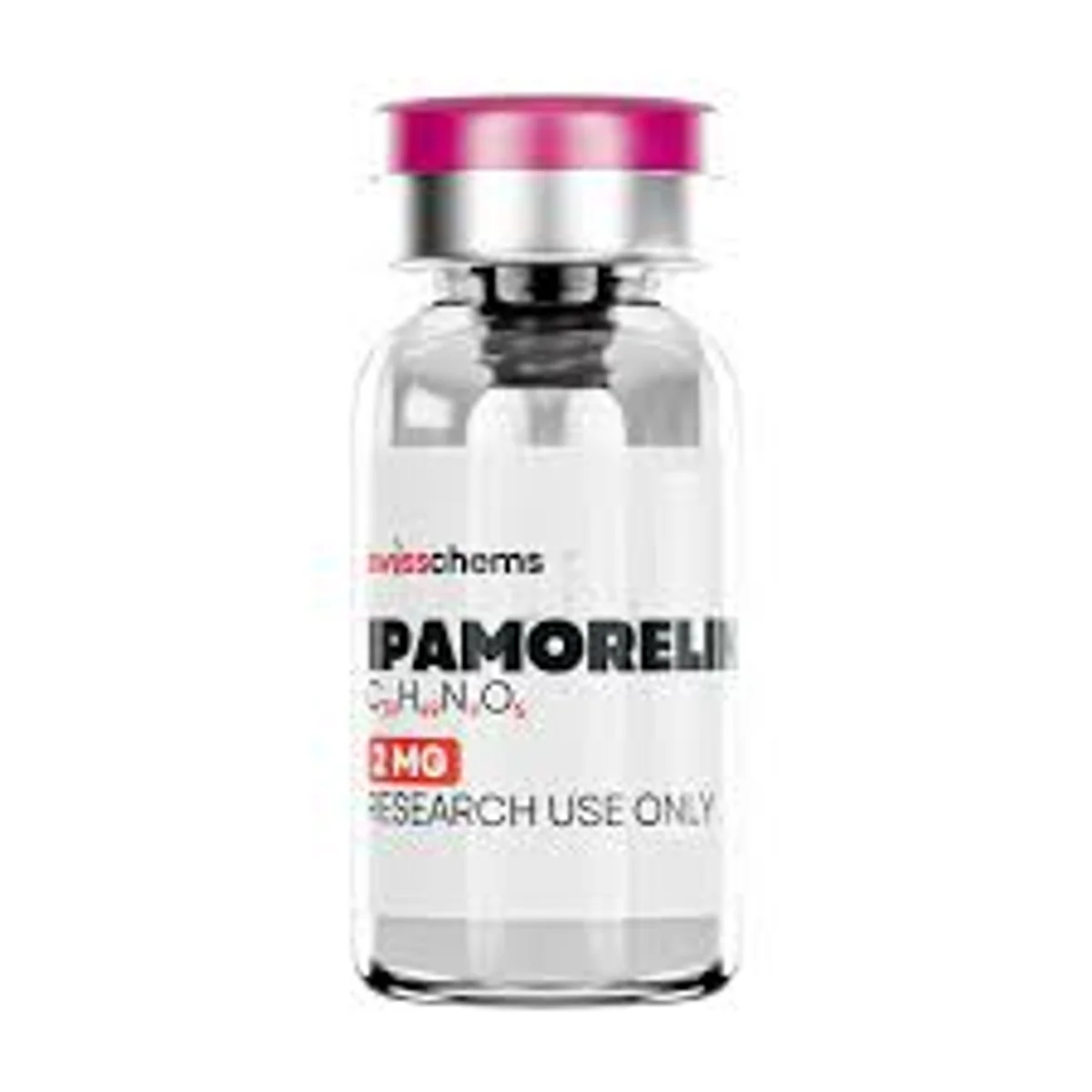
Research Peptide
Ipamorelin
Selective growth hormone secretagogue with a clean side-effect profile
“A highly selective GH secretagogue that studies suggest amplifies natural GH pulses while leaving cortisol and prolactin largely undisturbed.”
Last updated: April 23, 2026
Score Breakdown
Evidence
Purity
Cost Efficiency
Safety Profile
Pros & Cons
Pros
- Highly selective GHS-R1a agonist — research consistently shows minimal elevation of cortisol, prolactin, and ACTH compared to earlier-generation GHRPs
- Well-characterized mechanism of action with clear receptor pharmacology documented in peer-reviewed literature
- Relatively short half-life allows for physiologically pulsatile GH stimulation rather than sustained suppression of feedback systems
- Among the more extensively studied GHRPs in both animal models and early human clinical programs, giving a wider base of reference data than many research peptides
Cons
- Human clinical trial data in healthy adults is essentially absent — most body-composition and performance-related claims rest on animal studies and anecdotal self-reports
- Requires subcutaneous injection and cold-chain storage, adding logistical complexity compared to oral secretagogues like MK-677
- WADA-prohibited status creates meaningful risk for competitive athletes subject to anti-doping testing
Best For
- Researchers studying GH secretagogue selectivity and pulsatility in preclinical models
- Longevity-focused biohackers investigating age-related GH decline protocols (acknowledging the anecdotal evidence base)
- Academic review contexts comparing GHRP generations on cortisol-sparing profiles
Avoid If
- Active or history of hormone-sensitive malignancies, given GH and IGF-1 elevation may theoretically influence tumor biology
- Competitive athletes subject to WADA or USADA testing — ipamorelin is explicitly listed on the WADA prohibited substance list
Full Review
Ipamorelin (Ala-His-D-2-Nal-D-Phe-Lys-NH2) is a synthetic pentapeptide belonging to the growth hormone releasing peptide (GHRP) class, first described in the late 1990s by researchers at Novo Nordisk. It was developed as part of ongoing efforts to find selective, orally or parenterally administrable GH secretagogues. Unlike earlier generation GHRPs — GHRP-2 and GHRP-6 in particular — ipamorelin was specifically engineered to activate the ghrelin receptor (GHS-R1a) in the pituitary with high selectivity, producing GH release without the off-target activation of adrenocorticotropic hormone (ACTH), cortisol, or prolactin pathways that complicated earlier compounds. This selectivity profile is the primary reason ipamorelin attracted sustained research interest and remains among the most widely studied GHRPs in preclinical and limited clinical contexts.
The mechanism of action centers on ipamorelin's agonism at the growth hormone secretagogue receptor (GHS-R1a), located in the pituitary gland and hypothalamus. Binding at this receptor triggers a signaling cascade that results in pulsatile release of endogenous GH. Importantly, this release remains subject to the body's own somatostatin-mediated negative feedback, meaning it preserves the pulsatile, physiological pattern of GH secretion rather than producing sustained supraphysiological elevation. Research also suggests ipamorelin acts via partial ghrelin-pathway overlap, which may contribute to modest appetite signaling in some subjects, though this effect appears substantially weaker than that seen with GHRP-6. Downstream, elevated GH stimulates IGF-1 production from the liver, and it is largely through the IGF-1 axis that the compound's proposed anabolic and recovery-associated effects are thought to operate in animal models.
The evidence base for ipamorelin is meaningful but must be parsed carefully by study type. In animal models — primarily rodent studies — research has demonstrated significant GH and IGF-1 elevation, preservation of lean body mass, accelerated bone mineral density recovery in osteoporotic models, and improvements in gut motility parameters. A notable area of preclinical research involved ipamorelin's potential effects on postoperative ileus, where animal studies showed promising gastrointestinal motility restoration. Novo Nordisk advanced a related ipamorelin-based compound into early human clinical trials for postoperative ileus (Phase II/III, early 2000s), with results showing statistically significant reductions in time-to-bowel-recovery in surgical patients. However, this program was ultimately discontinued before regulatory submission, and the compound never reached approval. Outside of this clinical program, robust human-controlled trial data on ipamorelin's effects on body composition, recovery, or longevity markers in healthy adults remains sparse. A substantial portion of the surrounding discourse draws on extrapolation from animal studies, mechanistic inference, and self-reported user data from online communities — none of which constitute clinical evidence. This content is provided for educational purposes only and does not constitute medical advice or a recommendation for human use.
Dosing ranges reported in published preclinical research and referenced in the limited clinical literature vary considerably. Animal studies have used doses ranging from approximately 1 mcg/kg to 300 mcg/kg depending on endpoint studied. In the human postoperative ileus trials, IV administration protocols were used in controlled inpatient settings — not directly translatable to the subcutaneous research-chemical context in which ipamorelin is most commonly discussed. Anecdotal user reports in biohacking and bodybuilding communities most frequently reference doses of 200–300 mcg administered subcutaneously two to three times per day, often in combination with a GHRH analog such as CJC-1295, though this combination protocol has not been validated in controlled human trials. All dosing information here is reported from research and anecdotal contexts only and does not constitute a dosing recommendation under any circumstances. Individuals should not self-administer research chemicals.
Regarding legal status: in the United States, ipamorelin is not FDA-approved for any indication and is classified as a research chemical. It is not a DEA-scheduled controlled substance, but its sale for human consumption is prohibited under FDA regulations. It has appeared on the World Anti-Doping Agency (WADA) prohibited list as a peptide hormone. In the UK, ipamorelin sits in a regulatory grey zone as an unlicensed medicine; supply for human use without a prescription is prohibited under the Human Medicines Regulations 2012. In Australia, it is classified as a Schedule 4 substance (prescription-only) under the TGA framework, making its supply or possession without prescription illegal. The EU does not have harmonized scheduling for research peptides, but most member states treat unlicensed peptides similarly to the UK framework. Researchers and prospective buyers should verify applicable laws in their jurisdiction before procurement. From a sourcing standpoint, credible vendors should provide independently verified Certificates of Analysis (COA) from third-party laboratories showing HPLC purity (ideally ≥98%), mass spectrometry confirmation of molecular identity, and absence of common contaminants including bacterial endotoxins. Lyophilized powder is the standard commercial form; reconstituted solutions require bacteriostatic water and refrigerated storage.
Details
Reviews
No reviews yet. Be the first to share your experience.
Featured In
PROTOCOL-FRAMEWORK
Peptide Dosing Ranges Reported in Research: A Protocol Framework Reference (Not a Recommendation)
Peptide dosing ranges reported in published research span five evidence tiers, from FDA-approved Phase III RCT data (tirzepatide, semaglutide, tesamorelin) down to compounds where credible human dosing data is essentially absent. The strongest dataset belongs to tirzepatide, where SURMOUNT-1 (n=2,539, 72 weeks) reported approximately 20.9% mean body weight reduction at the 15 mg weekly dose versus placebo. Tier 1 compounds are prescription drugs accessed through licensed prescribers; Tiers 3–5 (including BPC-157, GHK-Cu, and ipamorelin) are not approved by the FDA, MHRA, TGA, or EMA for human therapeutic use.
STACK
Growth Hormone Secretagogue Stacks: How Ipamorelin + CJC-1295 Are Studied (2026 Research Guide)
Ipamorelin and CJC-1295 are research peptides studied as a growth hormone secretagogue stack, pairing a selective ghrelin receptor (GHS-R1a) agonist with a GHRH analog to stimulate endogenous GH release through two complementary pituitary pathways. Neither compound is FDA-approved for human use, and the peer-reviewed record contains no randomized controlled trials of the combination in healthy adults — the strongest human data is a Phase II pharmacokinetic trial of CJC-1295 with DAC, which extends circulating half-life to roughly 6–8 days via albumin binding. Tesamorelin remains the only FDA-approved GHRH analog with Phase III backing.
PEPTIDE-PROFILE
MK-677 (Ibutamoren): What the Research Shows on the Oral Growth Hormone Secretagogue
MK-677 (Ibutamoren) is the most comprehensively studied oral GH secretagogue in the research chemical space, with multiple completed double-blind, placebo-controlled human trials documenting sustained GH and IGF-1 elevation. Its oral bioavailability and documented sleep-architecture effects make it mechanistically interesting, but human trial evidence of insulin sensitivity impairment means any research application requires careful contextual scrutiny.
STACK
Peptide Stacks for Body Recomposition: How Researchers Combine GH-Axis, GLP-1, and Mitochondrial Compounds (2026 Research Guide)
For researchers building a GH-axis protocol with the strongest available human trial data, MK-677 (Ibutamoren) is the most defensible starting point - it's one of the only research chemicals in this class with completed double-blind, placebo-controlled human trials, oral administration, and documented GH/IGF-1 elevation. The insulin sensitivity impairment documented in those same trials, though, makes it a poor fit for any protocol layered with metabolic agents unless that interaction is explicitly part of the research question.
STACK
The GH-Axis Peptide Stack: CJC-1295, Ipamorelin, Sermorelin, and IGF-1 LR3 in Research Context (2026 Guide)
For researchers building a GH-axis peptide stack, CJC-1295 paired with Ipamorelin is the most evidence-supported GHRH+GHRP combination in the literature. CJC-1295 takes the top spot because of its published Phase II pharmacokinetic data (n=64), characterised mechanism at the GHRH receptor, and DAC modification that allows less frequent dosing. All compounds discussed here are research chemicals not approved for human use - this is a research-context summary only.