
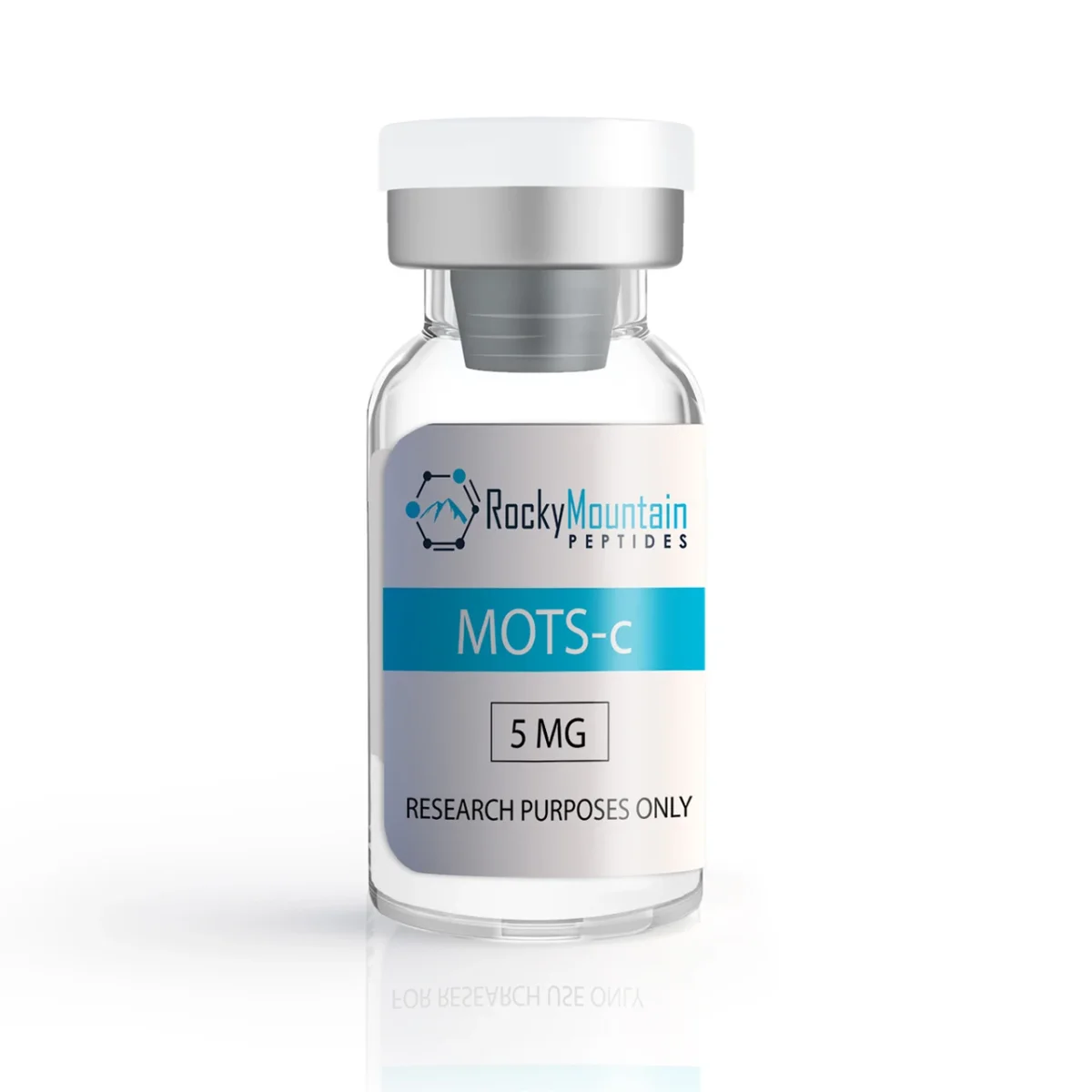
Research Peptide
MOTS-c
Mitochondrial peptide researched for metabolic and longevity signaling
“A mitochondria-encoded peptide studied for its role in metabolic regulation, insulin sensitivity, and biological aging.”
Last updated: April 23, 2026
Score Breakdown
Evidence
Purity
Cost Efficiency
Safety Profile
Pros & Cons
Pros
- Mechanistic rationale is well-established via AMPK pathway and mitochondrial biology research
- Naturally occurring endogenous peptide, suggesting baseline physiological compatibility in principle
- Cross-species animal data shows consistent metabolic and physical performance signals
- Growing academic research interest including centenarian population data adds credibility
Cons
- Human interventional trial evidence is preliminary and not yet replicated in large-scale RCTs
- Premium pricing relative to the thin human-trial evidence base
- Short estimated half-life and reconstitution requirement limit practical research convenience
Best For
- Researchers investigating mitochondrial-derived peptides in metabolic contexts
- Longevity-focused protocols examining AMPK pathway modulation
- Age-related insulin sensitivity and metabolic flexibility research models
Avoid If
- Seeking peptides with established, replicated human RCT evidence before sourcing
- Currently managing hypoglycemia or using insulin-sensitizing pharmaceuticals without medical supervision
Full Review
MOTS-c (Mitochondrial Open Reading Frame of the Twelve S rRNA type-c) is a 16-amino acid mitochondria-derived peptide (MDP) discovered and characterized by researchers at the University of Southern California in 2015. Unlike most peptides studied in the research-chemical space, MOTS-c is endogenously encoded within the mitochondrial genome — specifically within the 12S rRNA gene — making it a naturally occurring signaling molecule rather than a synthetic analog. It belongs to the emerging class of mitochondrial-derived peptides (MDPs), which also includes humanin and SHLP1-6, and is increasingly studied in the context of metabolic physiology and geroscience.
At the mechanistic level, research suggests MOTS-c acts as an exercise-responsive mitohormetic signal. Studies indicate it translocates to the nucleus under cellular stress conditions — particularly glucose restriction and exercise — where it appears to interact with the AMPK pathway, upregulate folate cycle activity, and modulate reactive oxygen species (ROS). Animal model data published in Cell Metabolism (Lee et al., 2015) demonstrated that exogenous MOTS-c administration improved insulin sensitivity, reduced obesity phenotypes in diet-induced obese mice, and activated AMPK in skeletal muscle. Separately, in vitro data suggest MOTS-c may suppress pro-inflammatory cytokine signaling, which has drawn interest in the context of age-related chronic inflammation.
The human evidence base for MOTS-c remains limited but directionally consistent. Observational data published in PNAS (2021) found significantly elevated plasma MOTS-c levels in Japanese centenarians compared to younger controls, lending credibility to its putative longevity association. A small human interventional pilot study conducted in older adults reported that exogenous MOTS-c administration was associated with improvements in insulin sensitivity and physical performance metrics, though this research remains preliminary and has not been replicated at scale. Animal studies in aged mice have shown improvements in physical endurance and metabolic markers, with one study reporting performance improvements in running tests. These effects are reported in animal and early-phase human research contexts and should not be extrapolated to guaranteed human outcomes. Anecdotal self-reports from the biohacking community describe improved exercise recovery, heightened energy levels, and subjective metabolic improvements, but these accounts carry no controlled-study validity.
Dosing ranges reported in published research contexts vary. Human pilot research has investigated doses in the range of 0.5–10 mg per administration, while animal studies have used weight-based dosing equivalent to approximately 5–15 mg/kg in murine models (not translatable directly to human dosing without pharmacokinetic bridging studies). Subcutaneous injection is the predominant route used in research settings. This information is reported from research contexts only and constitutes no recommendation for human use. Individual pharmacokinetics, safety at repeated human doses, and long-term effects have not been established through controlled human trials. Content on this page is for educational purposes only and is not medical advice.
Legal status: MOTS-c is not approved for human use by the FDA, MHRA, EMA, or TGA. It is currently sold exclusively as a research chemical in most jurisdictions and is not scheduled as a controlled substance in the US, UK, or EU as of the time of writing, though Australia's Therapeutic Goods Administration classifies unregistered peptides under increasingly restrictive scheduling frameworks. Sourcing quality varies significantly across vendors; researchers should prioritize suppliers providing HPLC-verified Certificates of Analysis from independent third-party laboratories, with mass spectrometry confirmation of molecular identity. Lyophilized powder form requires reconstitution with bacteriostatic water and should be stored frozen prior to reconstitution and refrigerated thereafter.
Details
Reviews
No reviews yet. Be the first to share your experience.
Featured In
STACK
The Longevity Stack: How Epithalon, MOTS-c, and Thymosin Alpha-1 Are Studied Together

The longevity peptide stack pairing Epithalon, MOTS-c, and Thymosin Alpha-1 is a research-only combination targeting three distinct hallmarks of aging: telomere attrition, mitochondrial dysfunction, and immunosenescence, respectively. None of the three compounds carry FDA, MHRA, or TGA approval for human administration, and the evidence base is highly uneven—Thymosin Alpha-1 has decades of clinical RCT data, MOTS-c has solid mechanistic and animal research with emerging human studies, and Epithalon's literature, though substantial in volume, originates largely from a single Russian research group (the Khavinson laboratory) with limited independent Western replication.
PEPTIDE-PROFILE
SS-31 / Elamipretide: The Mitochondrial-Targeted Peptide Research Summary
SS-31 (Elamipretide) ranks first in this guide because it carries more formal human RCT data than virtually any other research-chemical-status peptide - including registered Phase II and Phase III trials - with a well-characterized cardiolipin-binding mechanism and a consistently favorable safety profile across those trials. That said, the MMPOWER-3 Phase III primary endpoint failure is a material fact any serious researcher needs to weigh: mechanistic elegance doesn't automatically translate to clinical efficacy. This profile examines both sides without flinching.
CATEGORY-OVERVIEW
Peptides Studied for Fat Loss: GLP-1 Agonists, Mitochondrial Approaches, and Beyond (2026 Research Overview)

Prescription tirzepatide (Mounjaro / Zepbound) is the strongest-evidenced compound in this category by a significant margin. Phase III RCT data from SURMOUNT-1 shows up to ~21% mean body weight reduction at the 15mg dose, a signal no research chemical or investigational agent has come close to replicating in controlled human trials at scale. It's also legally accessible via prescription in all major markets, which puts it in a completely different category from the unregulated research chemicals covered elsewhere in this guide.
PEPTIDE-PROFILE
Spermidine: Autophagy and Cellular Renewal — What the Research Actually Shows
For researchers evaluating spermidine supplementation, it's one of the few longevity compounds with a completed human RCT, a well-characterized endogenous mechanism via EP300 inhibition and autophagy induction, and a decent safety profile at dietary-range doses. The evidence is still preliminary - but it's meaningfully more developed than most compounds in this space, and that distinction matters.
CATEGORY-OVERVIEW
Longevity and Anti-Aging Peptides: The 2026 Research Landscape — A Complete Category Overview
If you're evaluating longevity peptides by evidence quality rather than marketing copy, SS-31 (Elamipretide) is the most evidentially grounded research-chemical-status compound in this category. It's completed registered Phase II and Phase III human trials, has a well-characterized mitochondrial mechanism, and has a documented safety profile - though its Phase III primary endpoint failure means the clinical translation question is still genuinely open.
PEPTIDE-PROFILE
MOTS-c: The Mitochondrial-Derived Peptide Research Summary (2026 Evidence Review)
MOTS-c is a 16-amino acid mitochondrial-derived peptide (sequence MRWQEMGYIFYPRKLR) encoded within the 12S rRNA gene of the mitochondrial genome, first described by Lee et al. in a 2015 Cell Metabolism paper. Its proposed mechanism centers on AMPK activation via AICAR accumulation, with animal studies reporting improved insulin sensitivity, reduced fat accumulation, and enhanced endurance in rodent models. As of 2026, MOTS-c remains a research chemical with no FDA, EMA, MHRA, or TGA approval for any indication, and adequately powered human interventional trials have not been published.
STACK
Peptide Stacks for Body Recomposition: How Researchers Combine GH-Axis, GLP-1, and Mitochondrial Compounds (2026 Research Guide)

For researchers building a GH-axis protocol with the strongest available human trial data, MK-677 (Ibutamoren) is the most defensible starting point - it's one of the only research chemicals in this class with completed double-blind, placebo-controlled human trials, oral administration, and documented GH/IGF-1 elevation. The insulin sensitivity impairment documented in those same trials, though, makes it a poor fit for any protocol layered with metabolic agents unless that interaction is explicitly part of the research question.