
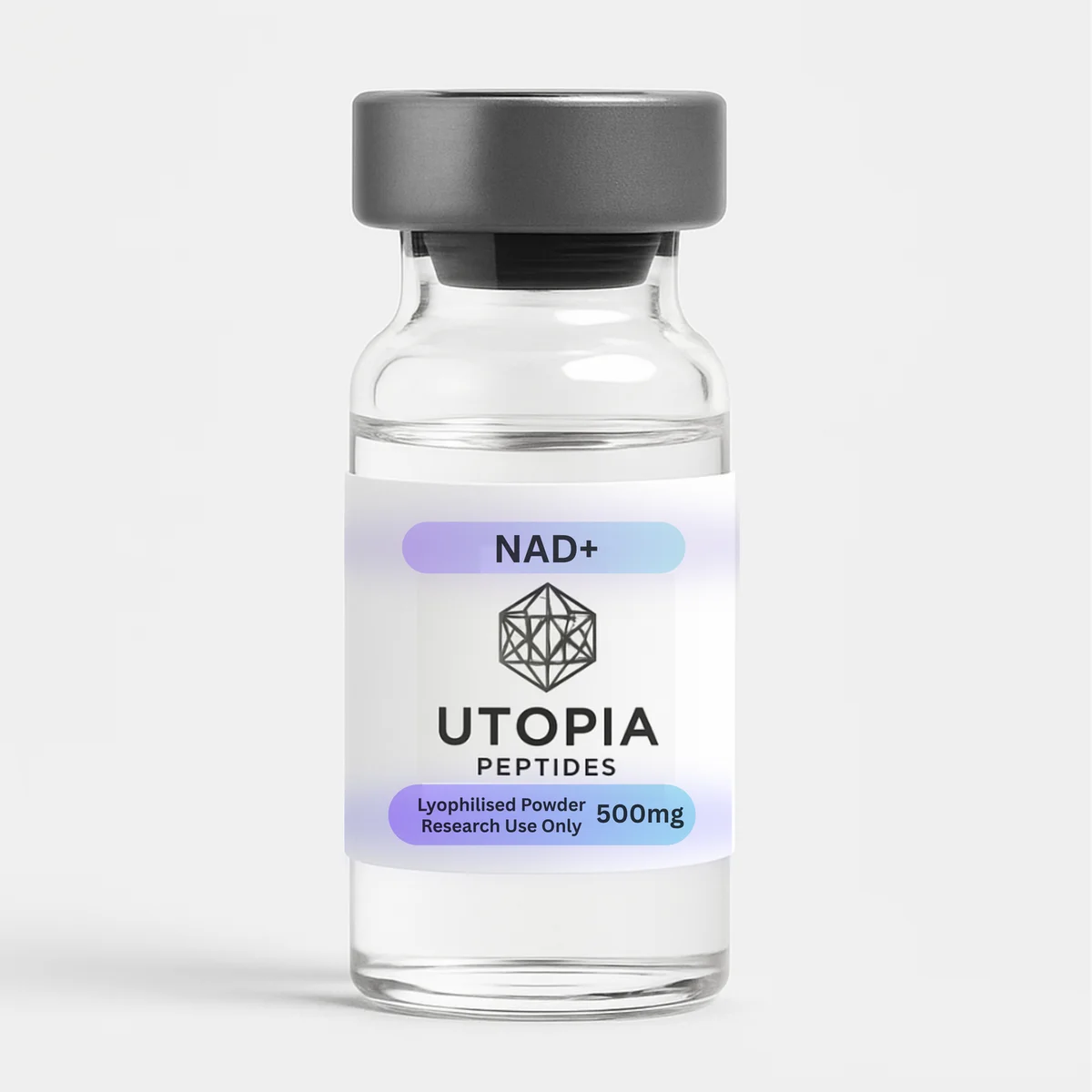
Research Peptide
NAD+ (Nicotinamide Adenine Dinucleotide)
Coenzyme central to cellular energy and longevity research
“The coenzyme at the center of cellular energy metabolism and aging biology — studied intensively in animal models, with emerging but still limited human trial evidence.”
Last updated: May 1, 2026
Score Breakdown
Evidence
Purity
Cost Efficiency
Safety Profile
Pros & Cons
Pros
- Exceptionally well-characterized mechanism of action — NAD+ biology is among the most studied pathways in aging research
- Injectable format bypasses gut degradation of oral NAD+, delivering the compound directly into circulation
- Broad downstream signaling relevance: sirtuins, PARP, CD38, mitochondrial function — multiple plausible longevity research rationales
- Oral precursor research (NMN, NR) provides a reasonably strong human evidence foundation that contextualizes the injectable compound's theoretical basis
Cons
- Human trial evidence for injectable NAD+ specifically is very thin — most published human data involves oral NMN/NR, not direct NAD+ injection
- Endotoxin contamination risk in injectable preparations is a meaningful safety concern that many research vendors do not adequately address with LAL testing
- High cost per effective dose relative to oral NMN/NR alternatives with better human-trial backing; preclinical pro-tumorigenic signals at supraphysiological doses warrant caution
Best For
- Longevity researchers investigating NAD+ metabolism and sirtuin pathway modulation in preclinical contexts
- Individuals with documented or suspected age-related NAD+ decline seeking to understand the research landscape before making supplementation decisions with a licensed provider
- Research contexts examining mitochondrial biogenesis and cellular energy metabolism biomarkers
Avoid If
- Active malignancy or personal/family history of cancer — preclinical data suggests NAD+ at supraphysiological levels may support tumor cell survival via PARP and CD38 pathways
- Unable to source injectable preparations with documented endotoxin testing — the IV/subcutaneous route carries infection and pyrogenic reaction risk without rigorous COA verification
Full Review
NAD+ (Nicotinamide Adenine Dinucleotide) is a dinucleotide coenzyme composed of adenosine monophosphate and nicotinamide mononucleotide, found endogenously in every cell of the human body. It is not a peptide by chemical definition — it contains no amino acid backbone — but it is routinely categorized alongside longevity-oriented research compounds and sold by peptide vendors in lyophilized injectable or oral supplement form. NAD+ belongs to the broader class of NAD precursor and NAD+ supplementation research, a field that has seen significant academic interest following foundational work from researchers including David Sinclair (Harvard) and Johan Auwerx (EPFL), who published extensively on sirtuin activation and mitochondrial NAD+ metabolism in aging models.
Mechanistically, NAD+ serves dual roles that make it a subject of intense longevity research. In its role as a redox coenzyme, it shuttles electrons during glycolysis and the citric acid cycle, directly enabling ATP synthesis. In its signaling role, NAD+ acts as the sole substrate for sirtuins (SIRT1–SIRT7), a family of deacylase enzymes linked to gene expression regulation, mitochondrial biogenesis, and stress response. It also fuels PARP enzymes involved in DNA repair and CD38, an ADP-ribosyl cyclase involved in calcium signaling. The mechanistic hypothesis underlying most NAD+ research is that age-associated NAD+ decline — documented in animal models and, more recently, in human tissue studies — impairs these downstream signaling pathways, contributing to metabolic dysfunction and cellular aging. Critically, most human supplementation delivers NAD+ precursors (NMN, NR) rather than NAD+ directly, since oral NAD+ is poorly bioavailable and largely degraded in the gut. Intravenous or subcutaneous administration of NAD+ itself bypasses this limitation, which is the rationale behind the injectable research compound format.
Evidence summary: Animal model evidence is the strongest pillar of NAD+ biology. Studies in mice — including landmark papers in Cell Metabolism (2013, Gomes et al.) and Nature (2013, Imai et al.) — demonstrated that NAD+ repletion via NMN or NR improved mitochondrial function, muscle endurance, and metabolic markers in aged animals. Human evidence is earlier-stage. A randomized, double-blind, placebo-controlled trial published in Nature Aging (2021, Yoshino et al., n=25) showed that NMN supplementation at 250mg/day increased skeletal muscle NAD+ metabolome markers and improved muscle insulin sensitivity in postmenopausal women with prediabetes, though broad clinical benefit was not established. A 2020 trial (Martens et al., Cell Reports Medicine, n=30) found oral NR at 1,000mg/day raised whole-blood NAD+ levels but did not significantly improve the cardiovascular or metabolic endpoints measured. For intravenous NAD+ specifically — the form most relevant to injectable research compound vendors — human trial data is substantially thinner, with most clinical evidence coming from small open-label studies in addiction medicine contexts and emerging longevity clinics. Anecdotal reports from users who have undergone IV NAD+ infusions frequently describe acute flushing, nausea, and a subjective sense of increased mental clarity, though these reports carry the limitations inherent to uncontrolled self-experimentation. The distinction between precursor supplementation (NMN, NR — oral, well-studied) and direct NAD+ injection (injectable, research-chemical context, far less human trial data) is critical and frequently obscured in vendor marketing.
Dosing ranges reported in research contexts: Human trials involving NMN have used oral doses ranging from 250mg to 1,200mg per day. NR trials have used 1,000–2,000mg/day. IV NAD+ infusions in clinical addiction literature have used 500–1,500mg administered over several hours. Injectable NAD+ sold by research vendors is typically supplied in lyophilized vials of 500mg–1,000mg. Reported subcutaneous self-administration protocols from community forums describe 25–100mg doses, though these derive entirely from anecdotal sources with no peer-reviewed trial basis. This information is reported strictly from published research and community documentation — it does not constitute a dosing recommendation. This content is for educational purposes only.
Legal status and sourcing: NAD+ as an oral supplement is broadly legal and commercially available as a dietary supplement in the US, UK, EU, and Australia. Injectable NAD+ occupies a more ambiguous regulatory space — it is not FDA-approved as a drug for injection, and compounding pharmacies in the US have faced scrutiny over IV NAD+ preparation. When sold as a research chemical in injectable lyophilized form, it falls into the unregulated research compound category. Vendors should provide certificates of analysis (COA) from third-party labs confirming identity, purity, and absence of endotoxins (critical for any injectable compound). Endotoxin testing — confirming LAL (limulus amebocyte lysate) levels below accepted thresholds — is a non-negotiable marker of vendor credibility for any injectable research compound and is frequently absent from lower-tier suppliers. Buyers should treat vendors who cannot produce endotoxin-tested COAs for injectable preparations as disqualified regardless of price.
Details
Reviews
No reviews yet. Be the first to share your experience.
Featured In
PEPTIDE-PROFILE
Spermidine: Autophagy and Cellular Renewal — What the Research Actually Shows
For researchers evaluating spermidine supplementation, it's one of the few longevity compounds with a completed human RCT, a well-characterized endogenous mechanism via EP300 inhibition and autophagy induction, and a decent safety profile at dietary-range doses. The evidence is still preliminary - but it's meaningfully more developed than most compounds in this space, and that distinction matters.
CATEGORY-OVERVIEW
Longevity and Anti-Aging Peptides: The 2026 Research Landscape — A Complete Category Overview
If you're evaluating longevity peptides by evidence quality rather than marketing copy, SS-31 (Elamipretide) is the most evidentially grounded research-chemical-status compound in this category. It's completed registered Phase II and Phase III human trials, has a well-characterized mitochondrial mechanism, and has a documented safety profile - though its Phase III primary endpoint failure means the clinical translation question is still genuinely open.