
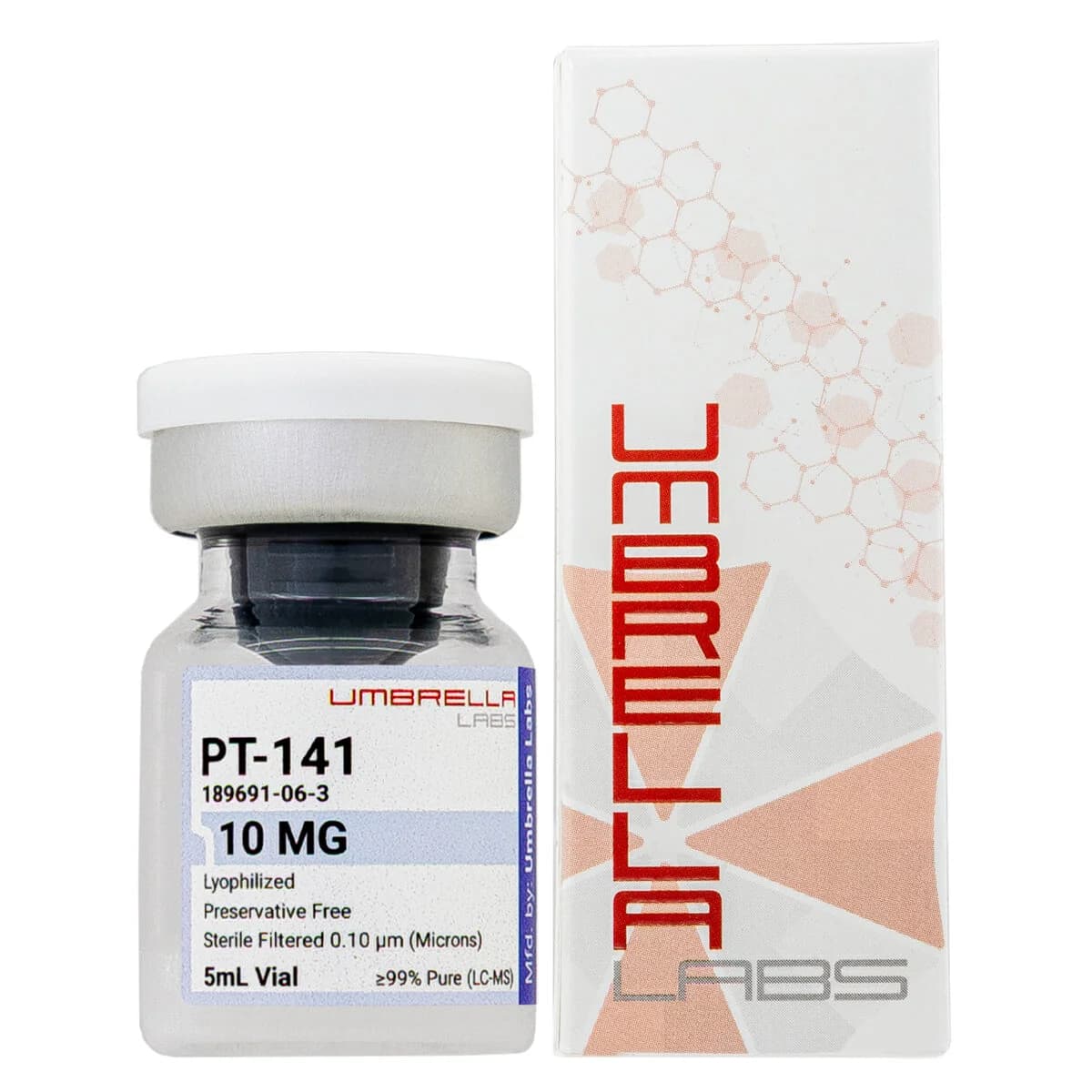
Research Peptide
PT-141 (Bremelanotide)
Melanocortin-based peptide studied for sexual arousal
“The only peptide class with an FDA-approved sexual health drug in its family — but research-chemical PT-141 is not that drug.”
Last updated: April 23, 2026
Score Breakdown
Evidence
Purity
Cost Efficiency
Safety Profile
Pros & Cons
Pros
- Mechanistic basis supported by robust human RCT data — among the strongest evidence profiles of any peptide in this category
- FDA-approved analog (Vyleesi) validates the core mechanism and provides a legitimate prescription pathway
- CNS-mediated mechanism of action is distinct from PDE5 inhibitors, representing a meaningfully different pharmacological target
- Rapid onset studied in trials (45–90 minutes to effect window) suits on-demand use patterns
Cons
- Nausea incidence in Phase 3 trials was high (approximately 40% of subjects), which is a clinically significant tolerability concern
- Research-chemical form lacks the sterility assurance, excipient formulation, and dosing precision of the FDA-approved Vyleesi product
- Transient hypotension risk — contraindicated with cardiovascular disease and nitrate medications, creating meaningful safety constraints
Best For
- Research into melanocortin receptor pathways and centrally-mediated sexual arousal mechanisms
- Investigators examining non-vascular pathways to sexual dysfunction intervention
- Comparative mechanistic study against PDE5-inhibitor class compounds
Avoid If
- History of cardiovascular disease or current use of nitrate medications — hypotensive interaction risk is documented
- Seeking a substitute for the FDA-approved Vyleesi formulation — the research chemical is not equivalent in formulation, sterility, or regulatory standing
Full Review
PT-141, also known by its INN bremelanotide, is a cyclic heptapeptide and synthetic analog of alpha-melanocyte-stimulating hormone (α-MSH). It belongs to the melanocortin peptide class and was developed from Melanotan II research, originally targeting skin pigmentation. Unlike Melanotan II, PT-141 was engineered to remove the tanning activity while preserving central nervous system activity relevant to arousal and sexual function. A formulated subcutaneous injection version, marketed as Vyleesi by AMAG Pharmaceuticals, received FDA approval in June 2019 for the treatment of acquired, generalized HSDD in premenopausal women — making bremelanotide one of the very few peptides with a legitimate clinical approval pathway. Research-chemical PT-141, however, is a distinct commercial context: lyophilized powder sold without the pharmaceutical excipients, stability controls, or sterility assurances of the approved drug, and is not approved for human use in this form.
The mechanism of action distinguishes PT-141 from the dominant class of sexual dysfunction drugs. Rather than acting on vascular smooth muscle or inhibiting PDE5 enzymes, research indicates PT-141 functions as an agonist at melanocortin receptors MC3R and MC4R in the central nervous system — specifically in hypothalamic and limbic regions implicated in sexual motivation and arousal. Animal model studies in rodents demonstrated dose-dependent increases in sexual motivation behaviors, and mechanistic research suggests the pathway operates upstream of the genital vascular response, potentially explaining why the compound appears to affect subjective desire rather than only physical response. This CNS-first mechanism is considered its key differentiator in published literature.
The evidence base for PT-141/bremelanotide is stronger than most peptides covered on this platform, owing to the FDA approval process for Vyleesi. Pivotal Phase 3 trials (RECONNECT studies, published circa 2016–2018) enrolled over 1,200 premenopausal women with HSDD across two randomized, placebo-controlled trials. These trials reported statistically significant improvements in satisfying sexual events and desire scores versus placebo, though effect sizes were modest — mean increases of approximately 0.5 additional satisfying sexual events per month. Smaller Phase 2 trials also examined male sexual dysfunction, with preliminary data suggesting improvements in erectile function scores in men with psychogenic or mixed-etiology ED, though this indication did not advance to a Phase 3 program. Anecdotal user reports in online research communities frequently describe rapid onset of arousal-related effects within 45–90 minutes of dosing, along with flushing and nausea as common accompanying effects. These user reports are not controlled observations and should be weighted accordingly.
Dosing in the approved Vyleesi formulation is 1.75 mg subcutaneously, administered no more than once per 24 hours and no more than once per 8 days, as studied in the Phase 3 trials. In earlier Phase 2 research involving men, doses from 0.5 mg to 2.0 mg subcutaneous were examined. Research-chemical PT-141 is often referenced in similar ranges in self-report communities, but these are extrapolations from pharmaceutical trial data applied to an uncontrolled context. All dosing information presented here reflects ranges reported in published research contexts — this is not a dosing recommendation, and self-administration of unformulated research chemicals carries risks distinct from clinical pharmaceutical administration.
In terms of legal status, Vyleesi (bremelanotide) is an FDA-approved prescription drug for HSDD in premenopausal women in the United States; the approved drug must be obtained through a licensed prescriber and pharmacy. The raw research-chemical form of PT-141 (lyophilized peptide powder) is not scheduled under the Controlled Substances Act in the US but is unregulated as a research chemical and not approved for human use — a meaningfully different legal and safety context. In the UK, EU, and Australia, no equivalent approval exists for bremelanotide; it is generally classified as an unregulated research chemical, though importation and use are subject to evolving regulatory scrutiny. Sourcing PT-141 as a research chemical rather than accessing bremelanotide through a legitimate prescription pathway represents a meaningful regulatory and quality-assurance departure. Anyone seeking bremelanotide for its studied indication should pursue the prescription pathway for Vyleesi. This content is published for educational purposes only and does not constitute medical advice.
Details
Reviews
No reviews yet. Be the first to share your experience.
Featured In
PEPTIDE-PROFILE
PT-141 (Bremelanotide) Research Summary: Mechanism, Evidence, and Legal Status
PT-141 (bremelanotide) is a synthetic cyclic heptapeptide and melanocortin receptor agonist (acting primarily at MC3R and MC4R) that the FDA approved as Vyleesi on June 21, 2019, for acquired, generalized hypoactive sexual desire disorder in premenopausal women. The approval was supported by the Phase 3 RECONNECT program (Studies 301 and 302), two placebo-controlled trials enrolling roughly 1,200 women using 1.75 mg subcutaneous injections. Research-chemical PT-141 shares bremelanotide's amino acid sequence but is not manufactured to pharmaceutical GMP standards and carries no approved indication; legitimate clinical access requires a Vyleesi prescription.
PEPTIDE-PROFILE
Melanotan II: What the Research Shows — and Why the Safety Record Matters
Melanotan II is a synthetic cyclic analog of alpha-MSH with real human trial data - small University of Arizona studies in the 1990s documented pigmentation and erectile effects - and an equally real adverse-event record: consistent dose-dependent nausea, flushing, spontaneous erections, and a growing cluster of case reports linking use to changing moles and melanoma diagnoses. It remains unapproved in every major jurisdiction. For the melanocortin mechanism it pioneered, the FDA-approved derivative bremelanotide (Vyleesi) - not the research chemical - is the defensible clinical route.