
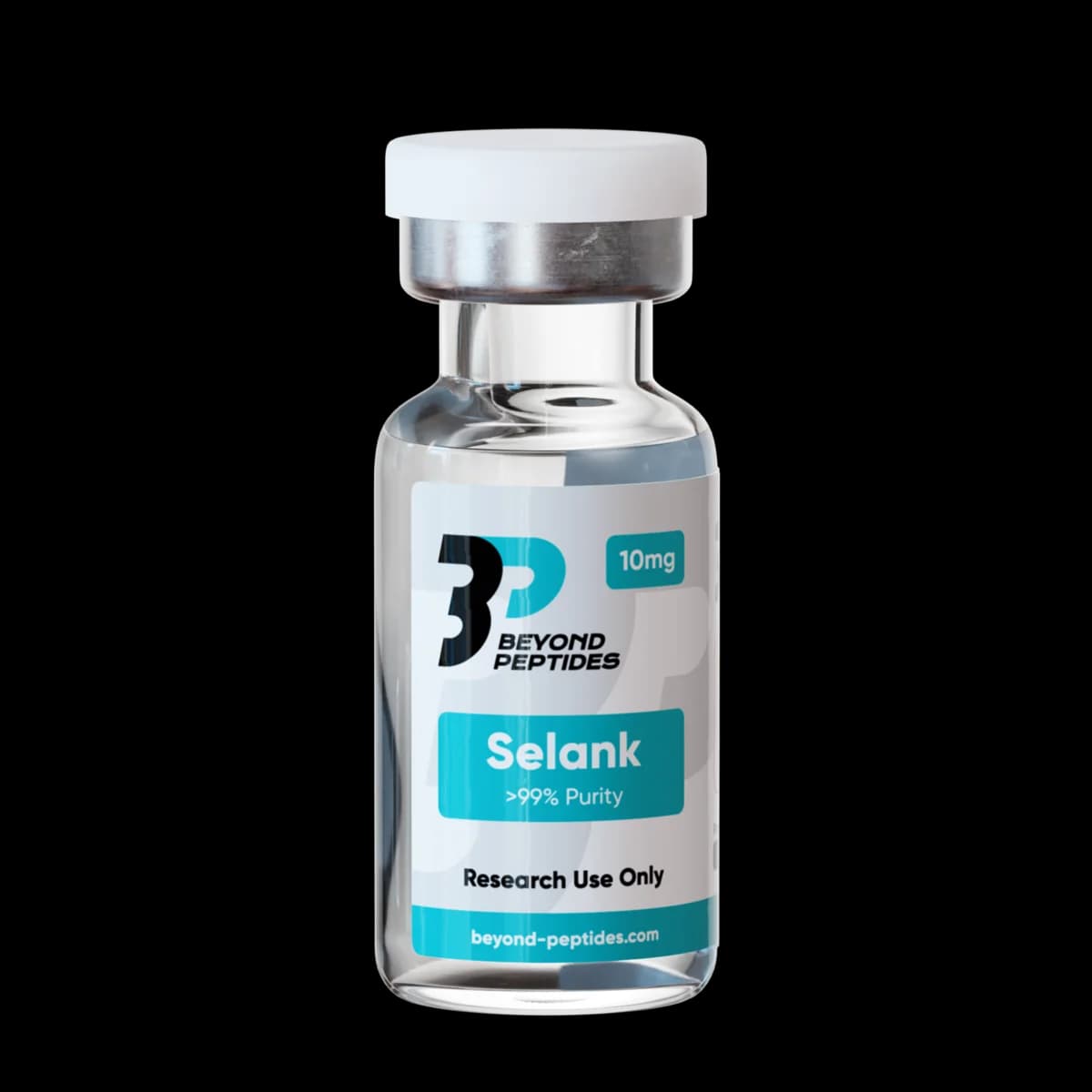
Research Peptide
Selank
Anxiolytic nootropic peptide with immunomodulatory research profile
“A Russian-developed anxiolytic peptide with a cleaner-than-benzo profile — backed by institutional Soviet-era trials and a notable absence of Western replication.”
Last updated: April 23, 2026
Score Breakdown
Evidence
Purity
Cost Efficiency
Safety Profile
Pros & Cons
Pros
- One of the few research peptides with any formal regulatory approval (Russia), providing at least some institutional clinical framework
- Intranasal delivery route is non-invasive and reported to offer rapid CNS uptake relative to peripheral injection
- Side-effect profile in Russian trials described as favorable, with no reported dependency or withdrawal in short-cycle research protocols
- Relatively affordable per-cycle cost compared to injectable peptides requiring larger volumes
Cons
- Virtually all controlled clinical evidence originates from Russian institutions with limited independent replication in Western peer-reviewed literature
- Short half-life (~1–2 hours) requires multiple daily administrations to maintain research-context exposure windows
- Mechanism of action involves several overlapping pathways (GABAergic, enkephalinergic, BDNF) that remain incompletely characterized, complicating safety extrapolation
Best For
- Researchers investigating GABAergic-adjacent anxiolytic peptide mechanisms without classical benzodiazepine receptor activity
- Cognitive-neurological research protocols focused on anxiety-cognition interaction models
- Immunomodulatory peptide research in conjunction with tuftsin-pathway studies
Avoid If
- Currently prescribed CNS-active medications (benzodiazepines, SSRIs, MAOIs) without independent research pharmacology review — interaction data is sparse
- Sourcing from vendors unable to provide batch-specific HPLC and MS-confirmed COAs, given the reconstituted injectable or intranasal route of administration in research contexts
Full Review
Selank (TP-7) is a synthetic heptapeptide with the amino acid sequence Thr-Lys-Pro-Arg-Pro-Gly-Pro, derived by fusing the tetrapeptide tuftsin (Thr-Lys-Pro-Arg) with a stabilizing Pro-Gly-Pro sequence. Tuftsin itself is an endogenous peptide fragment of IgG that plays a role in immune regulation and has demonstrated central nervous system activity. Selank was developed at the Institute of Molecular Genetics of the Russian Academy of Sciences and subsequently registered in Russia as a pharmaceutical agent, making it one of a small number of peptides in this guide with any formal regulatory approval — though exclusively within Russia, and not in Western jurisdictions. Outside Russia, it is sold as a research chemical and has no approved indication in the US, EU, UK, or Australia.
The proposed mechanism of action for Selank is multifactorial. Research suggests it modulates the GABAergic system, though not via direct benzodiazepine-receptor agonism, which may explain the anxiolytic effects observed in studies without the sedation or dependency profiles associated with classical anxiolytics. Additionally, preliminary research indicates Selank influences expression of brain-derived neurotrophic factor (BDNF), which connects to its putative nootropic and mood-stabilizing effects. Studies also suggest interaction with enkephalin metabolism — specifically inhibition of enkephalin-degrading enzymes — which may prolong endogenous opioid peptide activity in the CNS. Immunomodulatory effects, likely inherited from its tuftsin lineage, include reported modulation of interleukin and interferon expression, though the clinical significance of these effects in healthy humans remains unclear.
The evidence base for Selank is meaningful by peptide-research standards but carries important caveats. Russian clinical trials, some involving hundreds of participants, have examined its use in generalized anxiety disorder, neurasthenia, and cognitive deficits associated with anxiety states. A notable trial published in Russian-language literature (Semenova et al., 2009, and related work from the Institute of Molecular Genetics) reported statistically significant reductions in anxiety scores versus placebo in patients with GAD, with tolerability described as favorable. Animal model research — primarily in rodents — supports anxiolytic, nootropic, and immunostimulatory activity. However, virtually no independent, large-scale, peer-reviewed RCTs exist in Western literature, and replication outside Russian institutional contexts is minimal. User self-reports on English-language forums describe effects consistent with mild anxiolysis, improved verbal fluency, and mood stabilization, with a common observation that effects feel 'cleaner' than benzodiazepines. These anecdotal reports are not clinical evidence and should be interpreted accordingly.
Dosing ranges reported in published Russian research contexts — not a recommendation for human use — typically fall between 250 mcg and 3,000 mcg per day, most commonly administered intranasally in the clinical literature, with some subcutaneous protocols also described. Intranasal delivery is reported to offer rapid CNS uptake given the olfactory pathway bypass of the blood-brain barrier. Research protocols in Russian trials frequently used 250–500 mcg intranasal doses two to three times daily for periods of 10–14 days. These figures are drawn from research literature and are presented for informational purposes only; they do not constitute dosing guidance or a recommendation for human use. This content is for educational purposes only.
Outside Russia, Selank occupies the research-chemical category across all major Western regulatory jurisdictions. It is not FDA-approved, MHRA-approved, EMA-approved, or TGA-listed for any human indication. Buyers sourcing from Western vendors should treat it accordingly. When evaluating vendors, a credible certificate of analysis (COA) should include HPLC purity data (ideally >98%), mass spectrometry confirmation of the correct molecular weight (MW ~751.9 g/mol for the heptapeptide), and ideally endotoxin/LAL testing if injectable use is contemplated in a research context. Vendors who cannot provide a batch-specific COA from an accredited third-party laboratory should be avoided. Lyophilized powder form is standard; reconstitution with bacteriostatic water is typical, with refrigeration of reconstituted solution advised.
Details
Reviews
No reviews yet. Be the first to share your experience.
Featured In
STACK
Sleep Peptide Research Stack: DSIP, Selank, and Supporting Compounds for Sleep Quality and Recovery
For researchers building a sleep-focused peptide protocol, Selank is the strongest starting point among the three compounds covered here - it has at least some institutional clinical framework (including a formal approval in Russia), a non-invasive intranasal delivery route, and a mechanistic profile that connects anxiolytic signaling to downstream sleep architecture improvement in a way DSIP's stalled trial record and Epithalon's longevity-adjacent hypothesis simply don't match right now.
COMPARISON
Selank vs Semax: Two Russian Nootropic Peptides Compared by Mechanism, Evidence, and Research Context
For researchers focused on cognitive enhancement and neuroprotection mechanisms, Semax has the edge over Selank: its BDNF upregulation pathway is better characterized, its institutional trial base reaches into stroke and cognitive deficit research, and its pharmacological target is more clearly defined. The Russian-literature caveat applies equally to both compounds, and neither should be mistaken for a validated therapeutic.
CATEGORY-OVERVIEW
Nootropic Peptides: What the Research Actually Says About Selank, Semax, and Dihexa (2026 Evidence Review)
Nootropic peptides are short amino acid chains studied for effects on cognition, neuroplasticity, and mood through CNS pathways such as BDNF upregulation, GABAergic modulation, and HGF/MET signaling. Among the most-discussed compounds, Semax (an ACTH 4-10 analogue) and Selank (a tuftsin analogue) hold formal pharmaceutical registration in Russia with intranasal clinical trial data, while Dihexa has no published human trials and remains restricted to rodent research. None are FDA-approved or independently replicated in Western randomized controlled trials, and all are sold in Western jurisdictions only as research chemicals.
PEPTIDE-PROFILE
Semax: What the Research Actually Shows on the Russian Nootropic Peptide
Semax is the strongest option among the nootropic research peptides reviewed here because it combines a reasonably well-characterized mechanism (BDNF upregulation, ACTH analog activity) with genuine pharmaceutical registration in Russia and a published clinical trial record - but that evidence base is heavily concentrated in Russian-language literature and hasn't been independently replicated under Western regulatory standards, which limits how much confidence the available data can actually support.
PEPTIDE-PROFILE
Selank: What the Research Shows on the Russian Anxiolytic Peptide (2026 Evidence Review)
Selank is a Russian-developed anxiolytic heptapeptide - a tuftsin analog with the sequence Thr-Lys-Pro-Arg-Pro-Gly-Pro - registered in Russia as a 0.15% intranasal pharmaceutical. Institutional trials, including a 62-patient randomized comparison against the benzodiazepine medazepam (Zozulya 2008), report comparable anxiolytic effect without the sedation, tolerance, or dependence of classical anxiolytics, through GABA-modulatory and enkephalinase-inhibiting mechanisms. The critical limitation: essentially none of this evidence has been independently replicated outside Russia.