
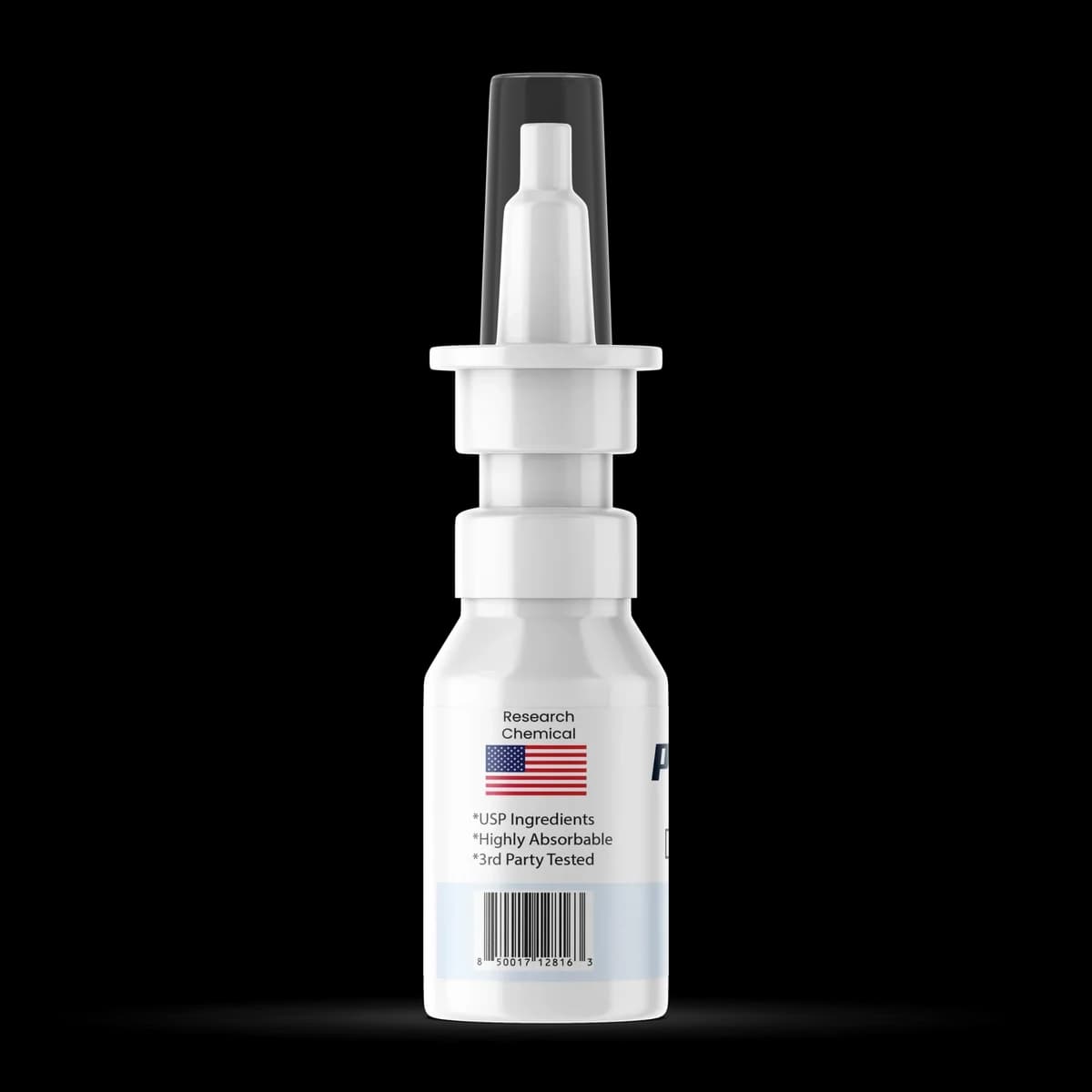
Research Peptide
Semax
Soviet-era nootropic peptide with serious research backing
“One of the few research peptides with actual registered pharmaceutical status — just not anywhere with rigorous Western regulatory oversight.”
Last updated: April 23, 2026
Score Breakdown
Evidence
Purity
Cost Efficiency
Safety Profile
Pros & Cons
Pros
- Has genuine registered pharmaceutical status in Russia with published clinical trial data — unusual depth of evidence for a research peptide
- BDNF upregulation mechanism is well-characterized and biologically plausible
- Intranasal delivery is non-invasive and reported to offer rapid CNS access via olfactory pathway
- Relatively benign reported side-effect profile in both clinical and anecdotal contexts
Cons
- Human trial evidence is heavily concentrated in Russian-language literature with limited independent Western replication or peer review by international standards
- Very short plasma half-life (~5–10 minutes) requires careful timing and storage protocols; pre-mixed intranasal solutions degrade rapidly
- Research-chemical status in Western jurisdictions means no quality control enforcement and significant batch-to-batch variability risk
Best For
- Researchers investigating BDNF modulation and neuroprotective peptide mechanisms
- Longevity-focused individuals exploring cognitive support peptides with a relatively established (if geographically narrow) evidence base
- Nootropics enthusiasts who have exhausted conventional cognitive interventions and understand the research-chemical risk profile
Avoid If
- History of anxiety disorders or psychological sensitivity — some self-reports indicate transient worsening of anxiety at higher doses
- Seeking FDA-cleared or clinically validated interventions — Semax has no approval pathway in the US, UK, EU, or Australia
Full Review
Semax is a synthetic heptapeptide (Met-Glu-His-Phe-Pro-Gly-Pro) structurally derived from the N-terminal fragment of adrenocorticotropic hormone (ACTH 4-10), with a Pro-Gly-Pro C-terminal extension added to improve metabolic stability. It was developed at the Institute of Molecular Genetics of the Russian Academy of Sciences and registered in Russia in 1991 as a pharmaceutical for use in ischemic stroke, transient ischemic attack, and cognitive impairment. It belongs to the melanocortin-related nootropic peptide class and is often grouped with peptide-based nootropics like Selank. For educational purposes only — the information that follows is a summary of published research and does not constitute medical advice or a recommendation for human use.
The primary mechanism of action reported in research involves upregulation of brain-derived neurotrophic factor (BDNF) and its receptor TrkB in limbic brain regions. Animal models also suggest Semax modulates serotonergic, dopaminergic, and cholinergic neurotransmission, and preliminary evidence points to inhibition of enkephalin-degrading enzymes, which may prolong endogenous opioid peptide activity. Additionally, research in rodent models has demonstrated anti-inflammatory effects through modulation of cytokine expression in brain tissue following ischemic injury. The intranasal delivery route appears to allow direct transport to the CNS via the olfactory pathway, which may explain the relatively rapid onset reported in both clinical and self-report contexts.
The evidence base for Semax is more substantial than for most research peptides, though it is heavily skewed toward Russian-language publications and institutional trials that are difficult to independently audit by Western standards. Human clinical trials — primarily conducted in Russia — have examined Semax in stroke rehabilitation, optic nerve disease, and cognitive decline, with some studies reporting sample sizes in the range of 50–200 patients and measurable improvements on neurological scoring scales. A notable area of investigation involves its use in ischemic stroke, where published Russian trials (notably work from Gusev et al. and associated research groups through the 2000s) reported improved functional outcomes with intranasal administration. Animal studies — predominantly in rodents — demonstrate neuroprotective effects in models of ischemia, and enhanced spatial learning and memory consolidation. Anecdotal user reports from nootropics communities (Longecity, Reddit r/nootropics) consistently describe improved focus, verbal fluency, and a mild anxiolytic effect, with some users noting mood enhancement. These self-reports should be weighted accordingly — they are uncontrolled and subject to significant placebo confounding.
Dosing ranges reported in published research contexts vary considerably by indication and delivery method. Intranasal dosing in clinical trials has typically ranged from 200–900 mcg per day, often administered as divided doses across a course of several weeks. Some Russian clinical protocols describe 0.1% nasal drop formulations delivering approximately 50–100 mcg per spray. Subcutaneous injection has also been studied, with ranges in the 200–500 mcg per day range in some animal and preliminary human protocols. IMPORTANT: These ranges are reported from research and clinical trial contexts only — they do not constitute a dosing recommendation. Semax is not approved for human use by the FDA, MHRA, or EMA, and no safe or effective dose has been established outside registered clinical contexts.
In terms of legal status, Semax is a registered pharmaceutical in Russia and Ukraine, available there by prescription. In the United States, it is unscheduled and not FDA-approved, existing in a research-chemical grey zone — legal to purchase for research purposes but not for human consumption. The same broadly applies in the UK and EU, where it lacks MHRA or EMA approval and falls into unregulated research-chemical territory. In Australia, it is not TGA-approved and would be considered an unapproved therapeutic good. Sourcing quality is a significant concern: reputable vendors should provide third-party HPLC and mass spectrometry certificates of analysis (COA) confirming identity and purity above 98%, along with endotoxin testing given the intranasal/injectable routes. Lyophilized powder requiring reconstitution is the most common research form; pre-dissolved intranasal formulations require cold-chain integrity and carry higher contamination risk if improperly handled.
Details
Reviews
No reviews yet. Be the first to share your experience.
Featured In
COMPARISON
Selank vs Semax: Two Russian Nootropic Peptides Compared by Mechanism, Evidence, and Research Context
For researchers focused on cognitive enhancement and neuroprotection mechanisms, Semax has the edge over Selank: its BDNF upregulation pathway is better characterized, its institutional trial base reaches into stroke and cognitive deficit research, and its pharmacological target is more clearly defined. The Russian-literature caveat applies equally to both compounds, and neither should be mistaken for a validated therapeutic.
CATEGORY-OVERVIEW
Nootropic Peptides: What the Research Actually Says About Selank, Semax, and Dihexa (2026 Evidence Review)
Nootropic peptides are short amino acid chains studied for effects on cognition, neuroplasticity, and mood through CNS pathways such as BDNF upregulation, GABAergic modulation, and HGF/MET signaling. Among the most-discussed compounds, Semax (an ACTH 4-10 analogue) and Selank (a tuftsin analogue) hold formal pharmaceutical registration in Russia with intranasal clinical trial data, while Dihexa has no published human trials and remains restricted to rodent research. None are FDA-approved or independently replicated in Western randomized controlled trials, and all are sold in Western jurisdictions only as research chemicals.
PEPTIDE-PROFILE
Semax: What the Research Actually Shows on the Russian Nootropic Peptide
Semax is the strongest option among the nootropic research peptides reviewed here because it combines a reasonably well-characterized mechanism (BDNF upregulation, ACTH analog activity) with genuine pharmaceutical registration in Russia and a published clinical trial record - but that evidence base is heavily concentrated in Russian-language literature and hasn't been independently replicated under Western regulatory standards, which limits how much confidence the available data can actually support.
PEPTIDE-PROFILE
Selank: What the Research Shows on the Russian Anxiolytic Peptide (2026 Evidence Review)
Selank is a Russian-developed anxiolytic heptapeptide - a tuftsin analog with the sequence Thr-Lys-Pro-Arg-Pro-Gly-Pro - registered in Russia as a 0.15% intranasal pharmaceutical. Institutional trials, including a 62-patient randomized comparison against the benzodiazepine medazepam (Zozulya 2008), report comparable anxiolytic effect without the sedation, tolerance, or dependence of classical anxiolytics, through GABA-modulatory and enkephalinase-inhibiting mechanisms. The critical limitation: essentially none of this evidence has been independently replicated outside Russia.