
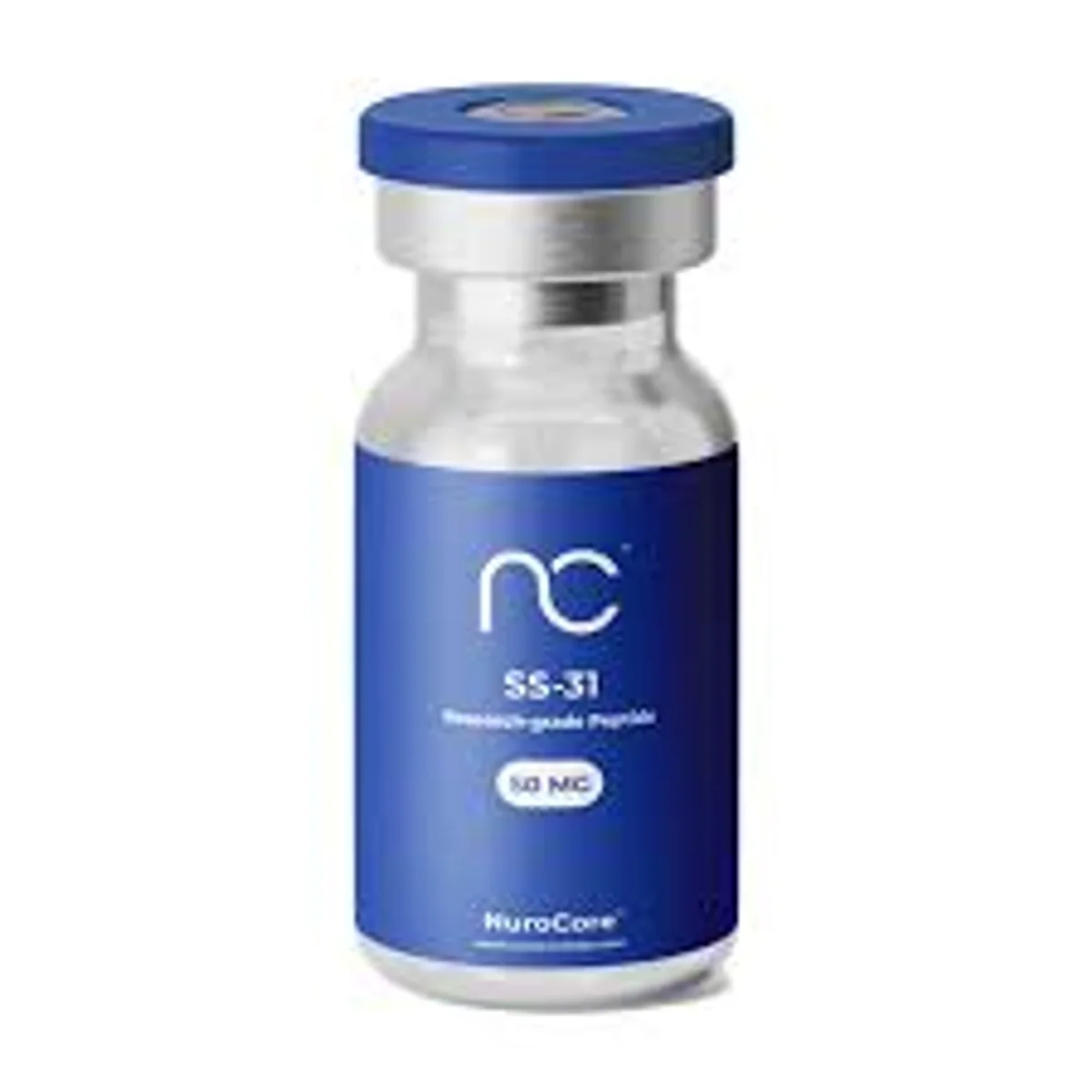
Research Peptide
SS-31 (Elamipretide)
Mitochondria-targeted peptide under active clinical investigation
“A cardiolipin-targeting mitochondrial peptide with more human clinical trial data than almost any other compound in this category — and more questions still unanswered.”
Last updated: April 27, 2026
Score Breakdown
Evidence
Purity
Cost Efficiency
Safety Profile
Pros & Cons
Pros
- More formal human RCT data than nearly any other research-chemical-status peptide, including registered Phase II and Phase III trials
- Mechanistically well-characterized: cardiolipin-binding and inner mitochondrial membrane targeting are supported by detailed in vitro and structural research
- Favorable observed safety profile across clinical trials — adverse events were generally mild and injection-site related
- Active in multiple disease models (cardiac, renal, skeletal muscle, auditory) suggesting broad mitochondrial relevance across tissue types
Cons
- MMPOWER-3 Phase III trial failure on primary endpoint raises meaningful questions about clinical translation of preclinical signals
- Extremely expensive relative to most research peptides; clinical-grade or even research-vendor pricing is high per milligram
- Synthesis complexity (non-standard amino acid 2′,6′-Dmt) increases the risk of sequence errors or purity issues from lower-tier vendors
Best For
- Researchers investigating mitochondrial membrane dynamics and cardiolipin biology
- Longevity-focused individuals specifically interested in mitochondrial quality and bioenergetic efficiency rather than hormonal pathways
- Those with a background in the clinical trial literature who understand the nuance of the MMPOWER failure and the HFpEF signal
Avoid If
- Sourcing from vendors unable to provide HPLC purity data and mass spectrometry confirmation of sequence accuracy — synthesis complexity makes this non-negotiable
- Expecting guaranteed outcomes based on preclinical data — the Phase III failure is a material caution against over-extrapolating animal model results
Full Review
SS-31 (elamipretide) is a synthetic aromatic-cationic tetrapeptide developed by Hazel Szeto and Peter Schiller at Weill Cornell Medicine, and subsequently advanced clinically by Stealth BioTherapeutics. Its full sequence is D-Arg-2′6′-Dmt-Lys-Phe-NH2, and its development was predicated on a foundational observation: the compound carries a net positive charge that enables it to accumulate selectively in the inner mitochondrial membrane at concentrations hundreds of times greater than systemic levels — a property that distinguishes it from generic antioxidants that operate non-specifically. It belongs to a class sometimes called 'Szeto-Schiller' or SS peptides, a small group of mitochondria-penetrating compounds, and SS-31 is by far the most clinically advanced member of that class.
The proposed mechanism of action centers on cardiolipin, a phospholipid unique to the inner mitochondrial membrane that plays a structural and functional role in organizing the electron transport chain complexes into 'supercomplexes.' Research suggests that under conditions of oxidative stress, aging, or ischemia, cardiolipin becomes oxidized and loses structural integrity, compromising proton gradient efficiency, increasing reactive oxygen species (ROS) production, and triggering apoptotic signaling via cytochrome c release. In vitro and animal model studies indicate that SS-31 binds directly to cardiolipin, stabilizing its association with cytochrome c, reducing electron leak and ROS generation at Complexes I and III, and restoring membrane potential. Importantly, this mechanism is not simple free-radical scavenging — it is structurally targeted, which is why the research community has regarded it with more seriousness than many antioxidant-class compounds.
The evidence base for SS-31 is genuinely more developed than most research peptides, though it stops well short of regulatory approval. In animal models (mouse, rat, canine, primate), published studies have reported improvements in cardiac output following ischemia-reperfusion injury, attenuation of age-related skeletal muscle decline (sarcopenia), improved renal function in models of acute kidney injury, and preservation of auditory function in noise-induced cochlear damage models. In human trials, Stealth BioTherapeutics conducted the MMPOWER-3 trial (n=218, 2019) in patients with primary mitochondrial myopathy — a Phase III RCT that did not meet its primary endpoint of improved exercise tolerance at 24 weeks, representing a notable setback for the clinical development program. However, secondary endpoints and earlier Phase II data suggested improvements in fatigue and patient-reported outcomes. A separate Phase II trial in heart failure with preserved ejection fraction (HFpEF, n=71, 2020) reported improvements in peak oxygen consumption and 6-minute walk distance versus placebo, considered a more encouraging signal. Additional Phase I/II data exist in the context of renal protection during cardiac surgery and in Barth syndrome. It should be stated clearly: none of these trials resulted in approval, and anecdotal self-reported use in the biohacking community remains a small and methodologically weak data source that should be weighted accordingly.
Dosing ranges reported in the published clinical literature — provided here strictly as research context and not as a recommendation for human use — have varied by indication. Intravenous infusions in cardiology trials used doses in the range of 0.05 to 0.25 mg/kg. The MMPOWER program used subcutaneous injections of 40 mg/day. Some earlier Phase I work explored single doses from 0.01 to 1.0 mg/kg IV. In preclinical rodent studies, doses of 1–5 mg/kg subcutaneously were commonly employed. The self-reported biohacker community, where subcutaneous administration is typical, tends to describe doses far lower than those in clinical trials — frequently in the range of 1–10 mg per session — though this falls entirely outside the framework of controlled research and should not be interpreted as validated or safe dosing. Reconstitution in bacteriostatic water is standard for lyophilized powder presentations. Reconstituted solution should be refrigerated and used within standard bacteriostatic water stability windows; lyophilized powder should be stored frozen and protected from light.
SS-31 carries an unusual legal and regulatory profile. It is not approved by the FDA, MHRA, EMA, or TGA for any human indication, and it is not a scheduled or controlled substance in major jurisdictions — placing it technically in the research-chemical-unregulated category in the US and UK. However, its formal clinical development history (IND, multiple registered trials) means it occupies a different category of regulatory scrutiny than compounds that have never entered formal drug development. In the US, sourcing SS-31 as a research chemical from peptide vendors is legal in the narrow sense of not being explicitly prohibited, but the FDA's authority over unapproved drugs used in humans remains relevant. COA verification from any vendor is non-negotiable: given the compound's complexity (a tetrapeptide with non-standard amino acid residues including 2′,6′-dimethyltyrosine), synthesis quality and sequence accuracy should be verified by HPLC purity data (>98% is the appropriate bar) and ideally mass spectrometry confirmation. Vendors who cannot provide both should be considered high-risk. This content is published for educational purposes only and does not constitute medical advice. Peptides described here are research chemicals not approved for human use.
Details
Reviews
No reviews yet. Be the first to share your experience.
Featured In
PEPTIDE-PROFILE
SS-31 / Elamipretide: The Mitochondrial-Targeted Peptide Research Summary
SS-31 (Elamipretide) ranks first in this guide because it carries more formal human RCT data than virtually any other research-chemical-status peptide - including registered Phase II and Phase III trials - with a well-characterized cardiolipin-binding mechanism and a consistently favorable safety profile across those trials. That said, the MMPOWER-3 Phase III primary endpoint failure is a material fact any serious researcher needs to weigh: mechanistic elegance doesn't automatically translate to clinical efficacy. This profile examines both sides without flinching.
CATEGORY-OVERVIEW
Longevity and Anti-Aging Peptides: The 2026 Research Landscape — A Complete Category Overview
If you're evaluating longevity peptides by evidence quality rather than marketing copy, SS-31 (Elamipretide) is the most evidentially grounded research-chemical-status compound in this category. It's completed registered Phase II and Phase III human trials, has a well-characterized mitochondrial mechanism, and has a documented safety profile - though its Phase III primary endpoint failure means the clinical translation question is still genuinely open.